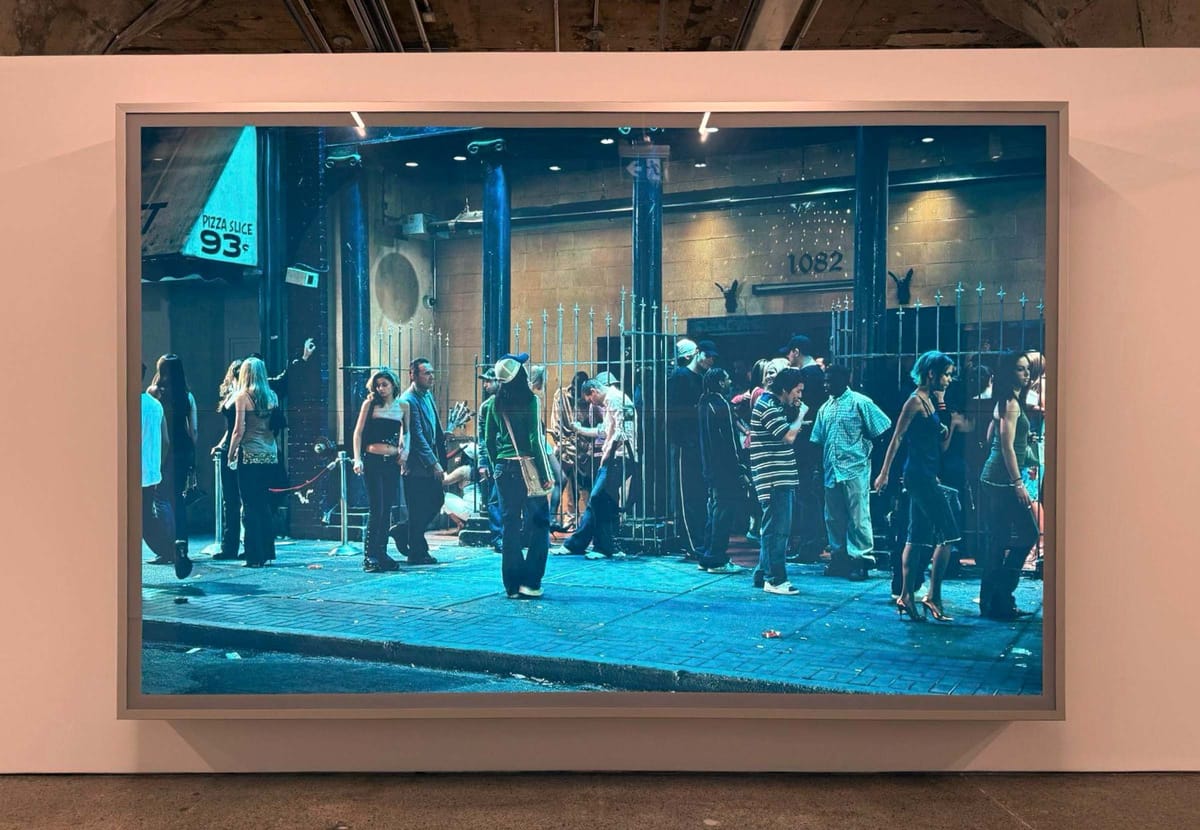
"Throughout his long career in photography, Jeff Wall has never been interested in capturing Henri Cartier-Bresson's "decisive moment." For more than four decades, the renowned Vancouver-based artist has treated the camera not as a tool for recording reality, but as a medium for playfully constructing it. But his body of work feels especially relevant - if a tad politically disengaged - right now, as we navigate AI-generated images, deepfakes, and questions about photographic reliability."
"Consider "The Flooded Grave" (1998-2000), where digital editing transforms a desolate burial site into an impossible vision: ocean water filling the grave's ready hollow, flecked with starfish, a beguiling image pulled from the artist's dreams. Or "Dead Troops Talk (a vision after an ambush of a Red Army Patrol, near Moqor, Afghanistan, winter 1986)" (1992), where fallen soldiers lie across a gnarled battlefield, appearing to converse openly after death."
Jeff Wall treats the camera as a means of constructing staged, meticulously composed images rather than recording spontaneous reality. A major survey at the Museum of Contemporary Art Toronto presents large-scale light boxes and carefully staged photographs spanning 1984–2023 across three floors. Digital editing and theatrical production create dreamlike or impossible scenarios, as in The Flooded Grave and Dead Troops Talk. The work provokes questions about photographic truth and visual reliability at a moment of AI-generated images and deepfakes. The images slow the viewer, suspend disbelief, and invite imaginative leaps while remaining somewhat politically disengaged.
Read at Hyperallergic
Unable to calculate read time
Collection
[
|
...
]