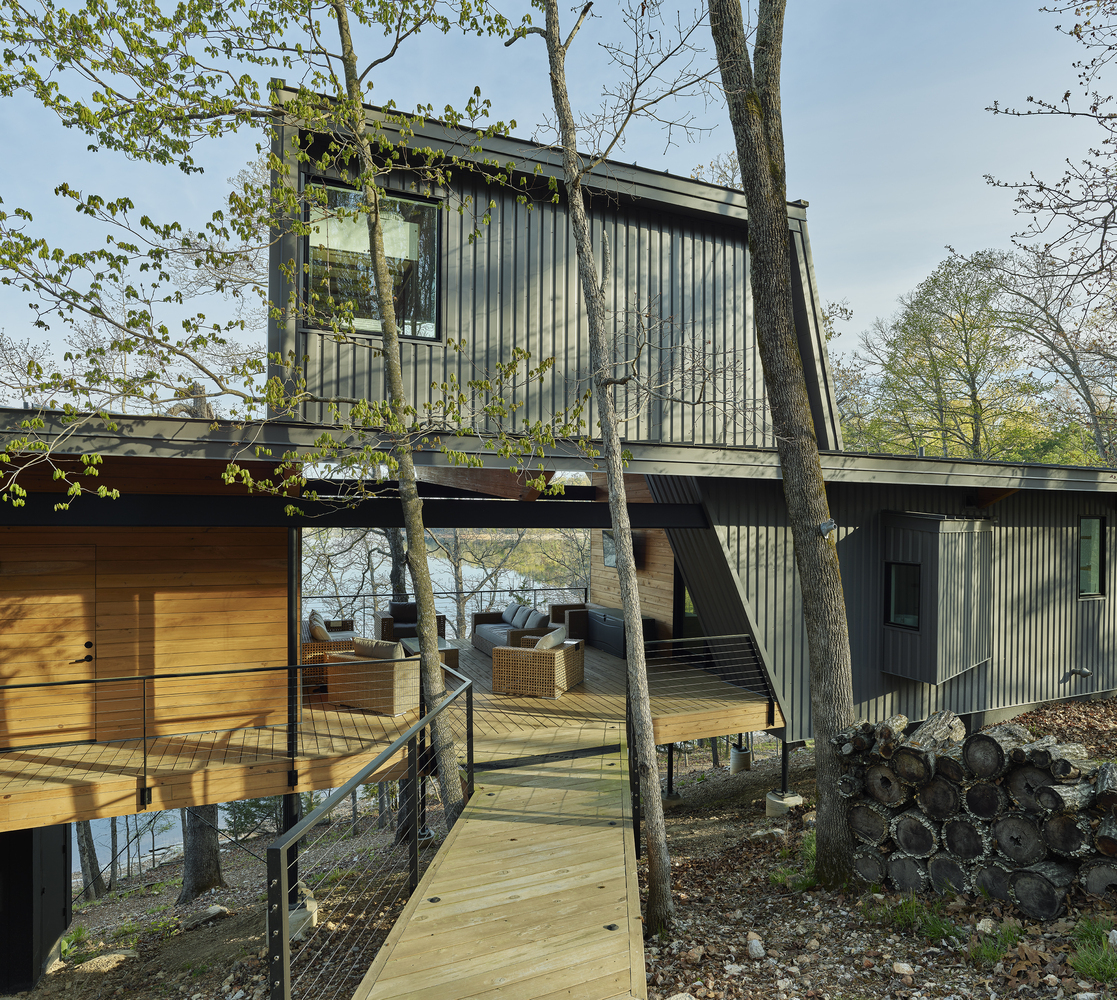
"The dogtrot house emerged across the South of the United States during the late nineteenth century as a direct response to humid climates, material availability, and patterns of rural habitation. Found throughout the Appalachian Mountains, coastal Carolinas, and lowlands of Louisiana, the dogtrot house appeared in numerous regional variations, yet its fundamental spatial logic remained remarkably consistent. Two enclosed living masses are separated by an open central passage and unified beneath a continuous roof, creating a dwelling that is simultaneously economical and responsive to long, hot summers."
"At the center of the dogtrot is the breezeway, an open passage that functioned as a circulation corridor and collective gathering space for the residents and neighbors. In the prolonged heat and humidity of Southern American summers, the breezeway became the environmental and social core of the house. Prevailing winds were drawn through the narrow opening, producing continuous cross ventilation that reduced heat without mechanical intervention."
"The name stems from the farm dogs that would typically sleep in the breezeway during the heat of the day, and indicates that domestic life expanded outward into a covered communal domain, connected to the surrounding landscape. Today, original dogtrot houses have become increasingly rare as modern construction systems and mechanical air conditioning have rendered many of their climatic strategies obsolete."
"This decline has also prompted renewed interest in the housing typology and the layers of vernacular intelligence embedded within it. Contemporary architects and designers are revisiting the dogtrot as a sophisticated spatial response to hot, humid conditions."
Dogtrot houses emerged across the southern United States in the late nineteenth century as a response to humid climates, available materials, and rural settlement patterns. The typology appears in many regional forms across the Appalachians, coastal Carolinas, and Louisiana lowlands, while keeping a consistent spatial logic. Two enclosed living masses sit on either side of an open central passage, all covered by a continuous roof. The breezeway serves as both circulation and a shared gathering space, drawing prevailing winds through the narrow opening to create cross ventilation and reduce heat without mechanical systems. The name reflects farm dogs that often slept in the breezeway during hot days, showing domestic life extending into a covered communal zone. Original examples are now rarer due to modern construction and air conditioning, prompting renewed interest in the typology’s climate-responsive vernacular intelligence.
#vernacular-architecture #climate-responsive-design #southern-us-housing #cross-ventilation #dogtrot-house
Read at ArchDaily
Unable to calculate read time
Collection
[
|
...
]