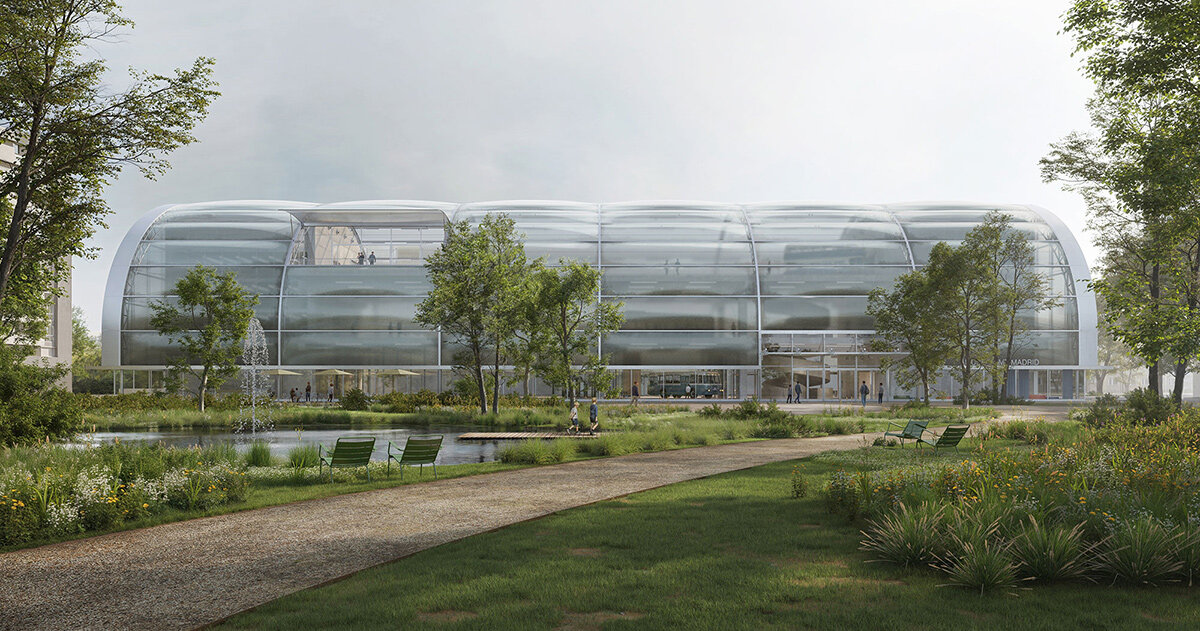
"Together with Frade Arquitectos, Luca Poian Forms envisions this EMT Museum as a landmark building dedicated to the transit history of Madrid. Conceived as a large civic presence on the site of the former Vicente Calderón Stadium, the project approaches its setting with measured geometry and a lightweight facade. Its scale reads as infrastructural, yet its profile and materiality remain soft."
"The EMT Museum is planned by Luca Poian Forms and Frade Arquitectos as an institutional home for Madrid's public transport history. It has been designed as part of an international competition, with a program to focus on movement, logistics, and collective memory. Industrial references drawn from depots and hangars inform the spatial organization, translated into a contemporary architectural language centered on efficiency and long-term adaptability."
"The building supports public exhibition areas alongside operational zones, arranged through clear circulation routes that support smooth daily use. Visitors enter at ground level onto an open, flexible floor that can accommodate exhibitions, workshops, conferences, and civic gatherings. Circulation paths remain legible and generous, encouraging slow movement through the galleries while maintaining operational efficiency behind the scenes. The museum functions as an active public interior, capable of shifting with changing curatorial needs and public programming."
The EMT Museum project places a civic landmark on the former Vicente Calderón Stadium site to preserve Madrid's public transport history. The building reads as infrastructural in scale while maintaining a soft profile through measured geometry and lightweight materiality. A translucent ETFE skin envelops the exterior, tempering physical mass and filtering daylight to create shifting interior atmospheres. Industrial typologies from depots and hangars inform efficient spatial organization and long-term adaptability. Public exhibition spaces sit alongside operational zones connected by clear, generous circulation routes. Ground-level flexible floors accommodate exhibitions, workshops, conferences, and civic gatherings while internal systems support evolving curatorial programs.
Read at designboom | architecture & design magazine
Unable to calculate read time
Collection
[
|
...
]