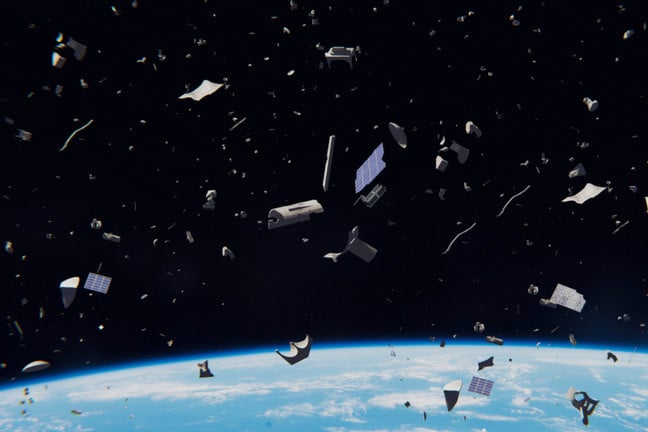
"The CRASH (Collision Realization And Significant Harm) Clock is a proposed Key Environmental Indicator (KEI) to give an estimate of how long it would take before a catastrophic collision occurs if collision avoidance maneuvers cease or there is a loss of situation awareness. The clock is currently 2.8 days, which doesn't sound too bad until you consider that in 2018, before the mega-constellation launches got underway (yes, Starlink, we're looking at you), the CRASH Clock was 121 days."
"Kessler Syndrome is a theoretical scenario where collisions in orbit result in an exponentially increasing amount of debris, effectively rendering some orbital regions unusable. As Lawler noted, the CRASH Clock is more about highlighting how crowded orbit is becoming and how quickly it could get worse in the event of something like a major solar storm or a software issue knocking out collision avoidance systems."
CRASH stands for Collision Realization And Significant Harm and functions as a Key Environmental Indicator estimating time until a catastrophic orbital collision if collision-avoidance maneuvers stop or situation awareness is lost. The current CRASH Clock reads 2.8 days, down from 121 days in 2018 before mega-constellation deployments. The metric highlights growing orbital congestion and the potential for rapid worsening from events such as major solar storms or software failures that disable collision-avoidance systems. If collision-avoidance systems continue to function flawlessly, immediate catastrophe is unlikely. In July, SpaceX submitted a report to the US Federal Communications Commission.
Read at Theregister
Unable to calculate read time
Collection
[
|
...
]