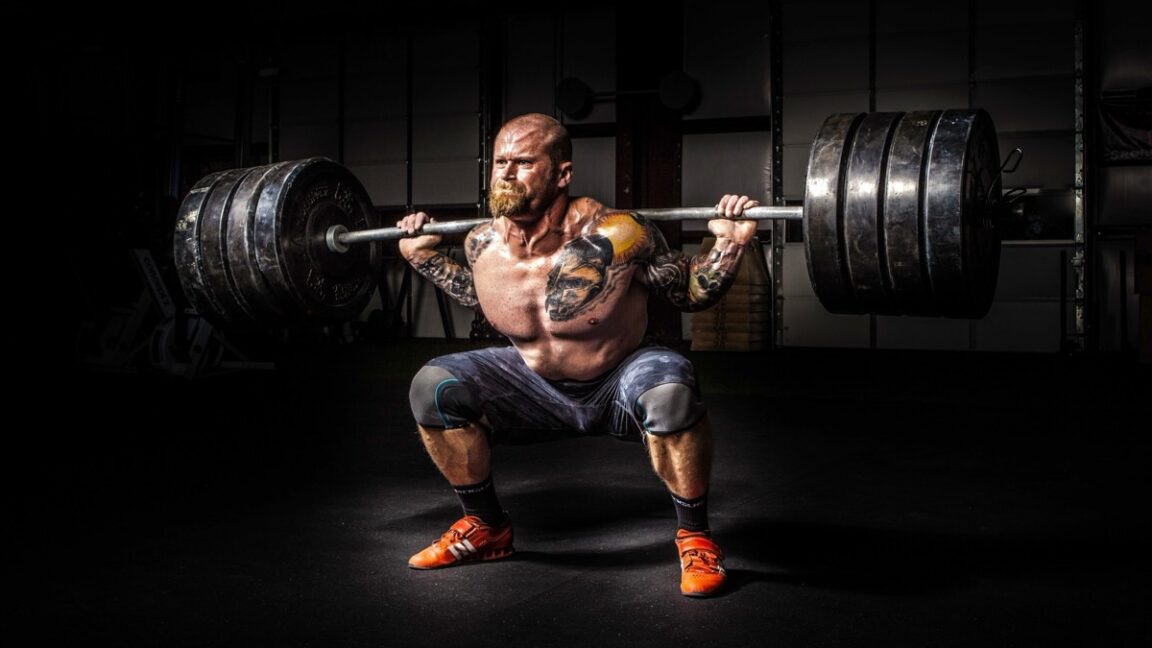
"“They told me how they use the whip,” Langlois said during a media briefing. “When they dip down, they can feel when the bar flexes back up and use that to accelerate the movement upward to increase the amount they can lift.”"
"Langlois decided to conduct a modal analysis, i.e., how an object moves or vibrates, to quantify the whip and better understand the mechanics, as well as what makes for a good barbell at the elite level. He suspended four 20-kg men's barbells (women use 15-kg barbells)-with 50 kg loaded on each end-from elastic resistance bands so that the bar was essentially floating in space. Then he attached accelerometers at each end of the bar where the vibrational mode patterns occur."
"Next he tapped set locations across the bar with a small hammer, measuring the acceleration at the end points, which enabled him to map out how the bars moved in response. He compared the vibrations of different barbells, as well as a single barbell loaded with different weights."
Olympic weightlifting uses the snatch, clean, and jerk, where athletes try to exploit how a barbell bends and recoils under load. This flexural bending, called the “whip,” helps lifters feel the bar flex back up and use that rebound to accelerate the movement upward. Scientists are investigating the mechanisms behind the whip using modal analysis, which measures how a bar vibrates and moves. A study suspended multiple 20-kg men’s barbells with heavy end loading so the bar effectively floated, then used accelerometers at key points and hammer taps to map vibrational mode patterns. The results compared different barbells and the same barbell under different weights to understand performance-relevant behavior.
Read at Ars Technica
Unable to calculate read time
Collection
[
|
...
]