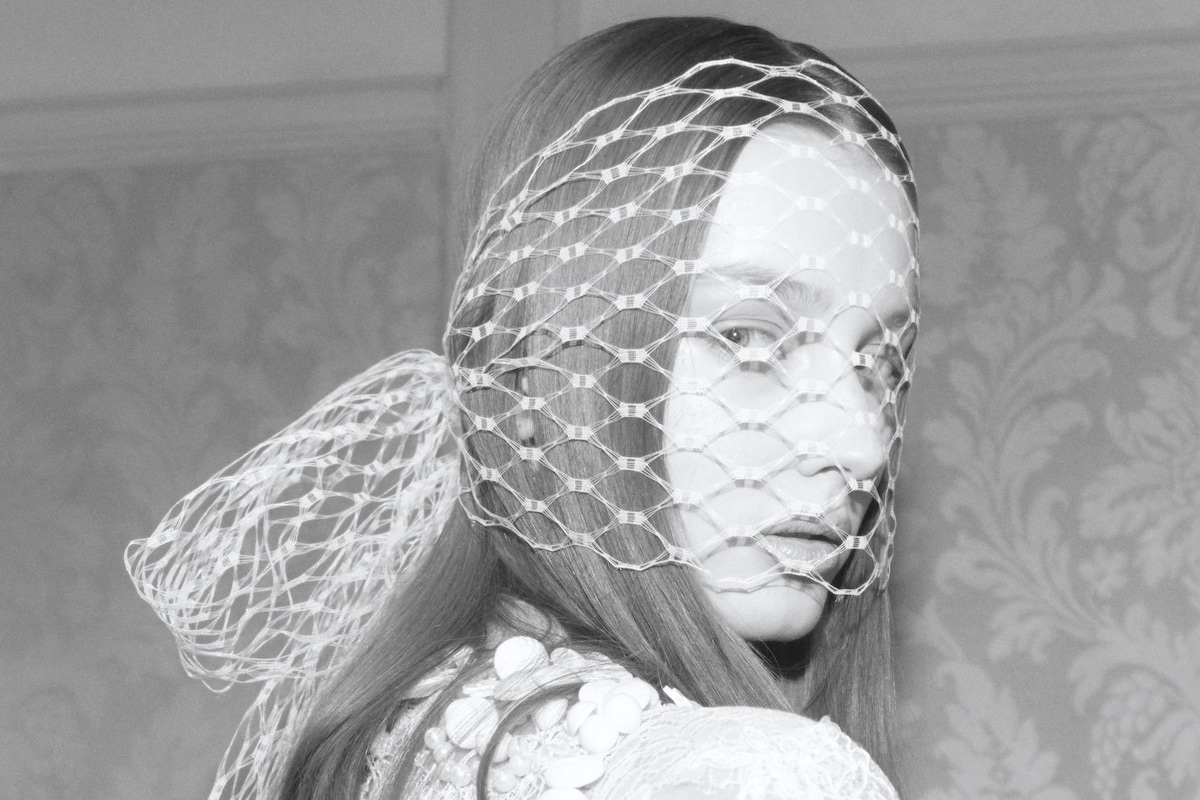
"Her Autumn/Winter 2026 collection leaned all the way in on that blue-blooded fiction. The starting point? A box of buttons she bought in the 90s as a child, which came crocheted directly into garments that clinked as they sauntered past. Around them spiral tangled yarns, shredded vintage lingerie, and old purses deconstructed into coats and bustiers, made to look like couture."
""[Lou de Bètoly]'s an anagram of my birth name," Odély Teboul, the French designer behind the Berlin-based label, told us. "The 'de' is very aristocratic - I wanted to play with that, with the idea that as an artist, I can be whoever I want." Push-up bras appear as shoulder pads, or sprout awkwardly and menacingly, from hips. Who knew the bra could be so versatile?"
"Titled Doppelgänger, it circled ideas of repetition and historical rhyme. Each seat held printed poems, including a 1934 line by Bertolt Brecht warning that those who avoid the fight still inherit the defeat. Designers Benjamin Alexander Huseby and Serhat Işık built the collection around the newly circulating term Friedensangst - fear of peace - reportedly coined around arms-industry jitters at the prospect of war ending."
Odély Teboul uses the alias Lou de Bètoly, an anagram of her birth name, to evoke aristocratic performance. Her Autumn/Winter 2026 work incorporated childhood buttons crocheted into garments that clinked, spiral yarns, shredded vintage lingerie, and deconstructed purses turned into coats and bustiers. Push-up bras were repurposed as shoulder pads or emerged from hips. GmbH staged A/W26 Doppelgänger at the Kraftwerk power plant, focusing on repetition, historical rhyme and the concept Friedensangst—fear of peace. Seats included printed poems, including a Brecht line about inheriting defeat. The collection mixed pointed thigh-high boots, skinlike bodies, and tailoring that balanced banker severity with nightclub fluidity.
Read at AnOther
Unable to calculate read time
Collection
[
|
...
]