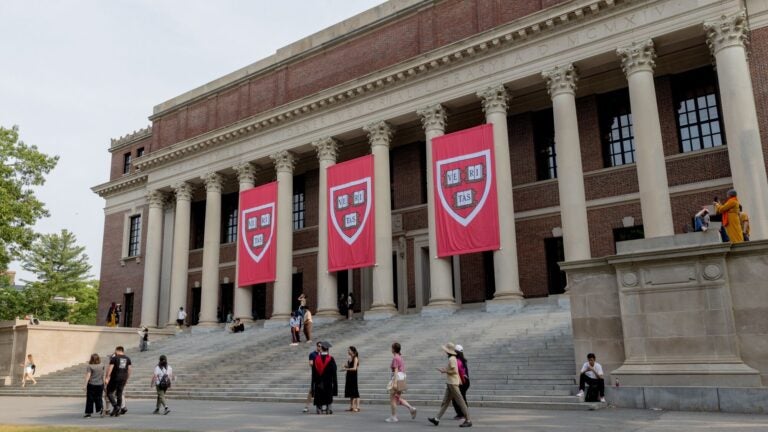
"“Our grading is too compressed and too inflated, as nearly all faculty recognize; it is also too inconsistent, as students have observed.” “More importantly, our grading no longer performs its primary functions and is undermining our academic mission.”"
"“Our grading is too compressed and too inflated, as nearly all faculty recognize; it is also too inconsistent, as students have observed.” “More importantly, our grading no longer performs its primary functions and is undermining our academic mission.”"
"A proposal from February outlines a plan to cap the number of potential As awarded at 20 percent of a given class, with room to award four additional As beyond 20 percent. In a class of 10, up to 60 percent of the class could earn As, or 6 students. In a class of 100 students, 24 students could earn As, the highest grade possible at Harvard."
"In her report, Claybaugh wrote that “many” faculty feel “powerless to grade otherwise,” citing tenure concerns, pressure from other faculty, and the need to maintain good enrollment in their classes. “No one wants to be an outlier,” she wrote. “With good enrollments come guaranteed teaching for graduate students, the possibilit"
Harvard faculty are voting on whether to cap the number of A grades in undergraduate courses to address grade inflation. The online vote runs until May 19. The proposal would limit A grades to 20 percent of a class, with an additional allowance of four A grades, and would not affect A- or other grades. The cap would change outcomes differently by class size, such as allowing up to 6 A grades in a class of 10 and up to 24 A grades in a class of 100. Dean Amanda Claybaugh reported that grading is overly compressed, inflated, and inconsistent, and that grading no longer fulfills its academic mission. She also cited faculty concerns about tenure, peer pressure, and enrollment incentives.
Read at Boston.com
Unable to calculate read time
Collection
[
|
...
]