"Broadly defined H. erectus ( H. erectus sensu lato) was widely distributed across three continents and was geologically long-lived1,2,3, lasting nearly 2 million years (Myr). Homo erectus is thought to have spread from East Africa into western Asia (1.8 Myr ago (Ma), Dmanisi, Georgia), marking the earliest generally accepted evidence of the genus Homo outside of Africa4,5. The earliest H. erectus specimen found in Europe is from the TE7 level of the Sima del Elefante site (Sierra de Atapuerca, Spain)6, dated between 1.4 Ma and 1.1 Ma."
"Nevertheless, the only molecular data previously recovered from H. erectus comprise peptides extracted from a 1.77-Myr-old tooth originating from Dmanisi in Georgia, West Asia. However, these sequences lack any single amino acid polymorphisms (SAPs) that can distinguish H. erectus from other human lineages11."
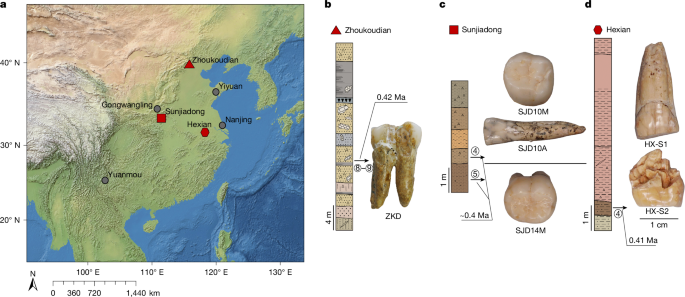
"The H. erectus specimen represented by the Zhoukoudian fossils dates from approximately 0.78 to 0.3 Ma during the Middle Pleistocene in northern China12,13. It is frequently used as the primary reference for the overall morphological characteristics of all H. erectus or Asian H. erectus14. This group has had a crucial role in research on the origin and evolution of H. erectus. Studies of the Zhoukoudian fossils have settled debates over whether the Indonesian Java fossils are apes or humans, confirming the systematic position of H. erectus within the human lineage14,15."
"In China, the record of H. erectus dates back to about 2.1-1.6 Ma (refs. 7,8,9) and disappears roughly 0.4-0.3 Ma (ref. 10). In Java, Indonesia, the fossils of H. erectus range from 1.5 Ma to as recent as 0.1 Ma. Overall, H. erectus has had an important role in human evolution. Understanding the molecular characteristics of this lineage is essential to help us to better understand hominin biology throughout the genus Homo."
Homo erectus sensu lato was widely distributed across three continents and lasted nearly 2 million years. The earliest generally accepted evidence of Homo outside Africa comes from East Africa to western Asia around 1.8 million years ago at Dmanisi, Georgia. The earliest European specimen comes from the TE7 level at Sima del Elefante in Spain, dated between 1.4 and 1.1 million years ago. After dispersing to China and Indonesia, H. erectus persisted for long periods. In China, it appears from about 2.1–1.6 million years ago and disappears around 0.4–0.3 million years ago. In Java, fossils range from 1.5 million years ago to as recent as 0.1 million years ago. Molecular data have been limited to peptides from a 1.77-million-year-old Dmanisi tooth, which lack distinguishing single amino acid polymorphisms. Zhoukoudian fossils from northern China, dated about 0.78–0.3 million years ago, serve as a key morphological reference for Asian H. erectus and have helped resolve debates about the status of Java fossils.
Read at Nature
Unable to calculate read time
Collection
[
|
...
]