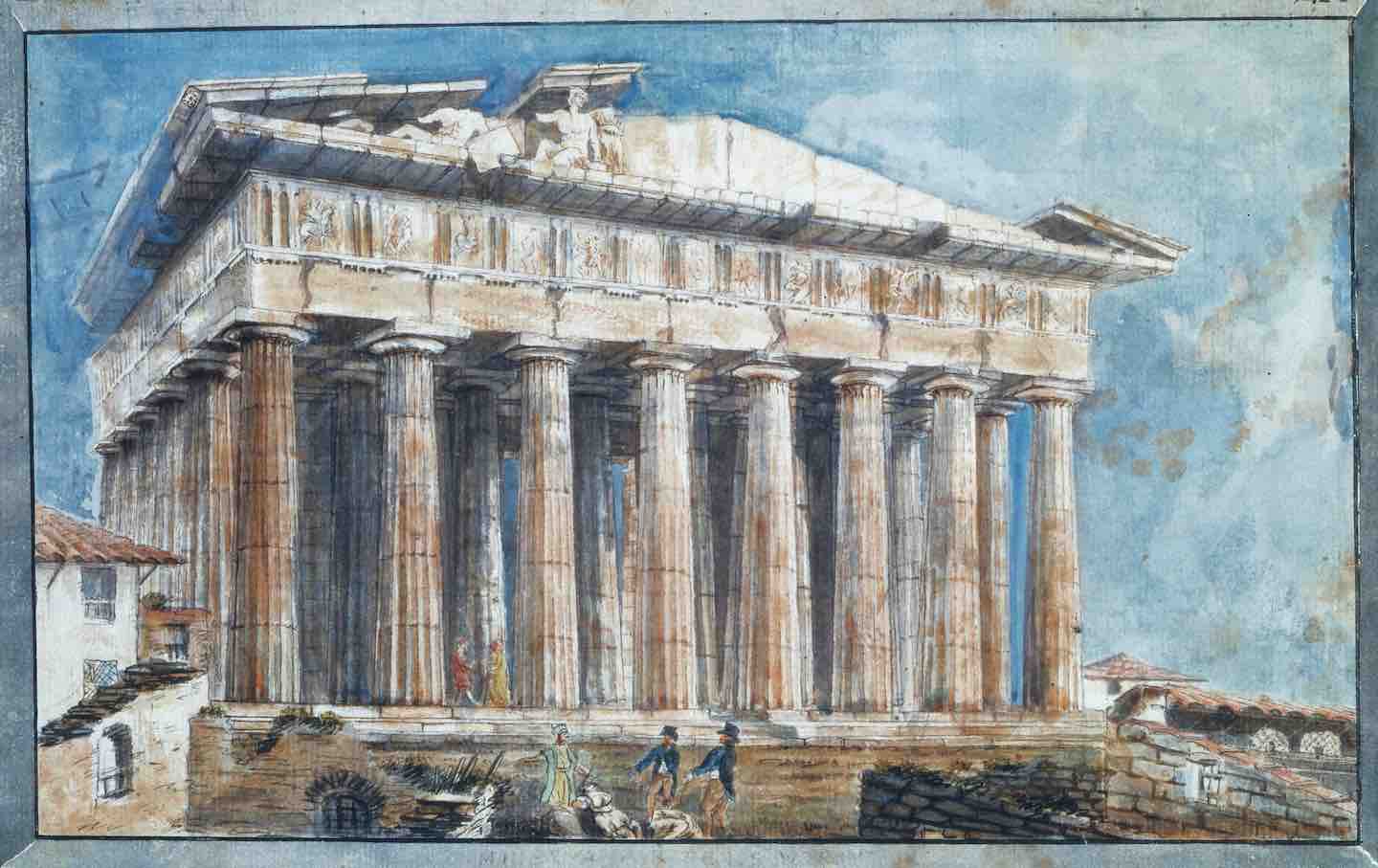
"Arguably the world's most famous Greek temple, the Parthenon was constructed in a flurry of building activity on the Acropolis of Athens, under the direction of the indefatigable statesman Pericles in the middle of the fifth century BC. It was a monument to recent tragedy in Athens as much as a celebration of the city's glory: The Acropolis had been leveled by Persian invaders in 480 BC, and its temples had been left in ruins for 30 years, a colossal absence reminding citizens how close they had come to annihilation."
"Today, the Parthenon is perhaps more famous for what is missing from it. When visitors clamber up the steep incline of the Acropolis to admire the temple, there is very little left of its sculptural program to see. This is largely thanks to Thomas Bruce, the seventh Earl of Elgin and British ambassador to the Ottoman court, who in the early 19th century removed roughly half of the Parthenon's surviving pediment statues, metopes, and frieze-along with other elements from the Acropolis, including a caryatid from the nearby Erechtheion-and had them shipped to England."
The Parthenon was erected on the Acropolis of Athens in the mid-fifth century BC under Pericles as part of a major rebuilding after Persian destruction in 480 BC. Athens used Delian League resources to fund reconstruction, creating the largest mainland Greek temple from Pentelic marble with an elaborate sculptural program and a continuous inner frieze. Phidias is credited as the project's leading sculptor. Much of the temple's sculpture is now missing because Thomas Bruce, the seventh Earl of Elgin, removed approximately half of the surviving sculptures and shipped them to England, a removal whose legality remains contested.
Read at The Nation
Unable to calculate read time
Collection
[
|
...
]