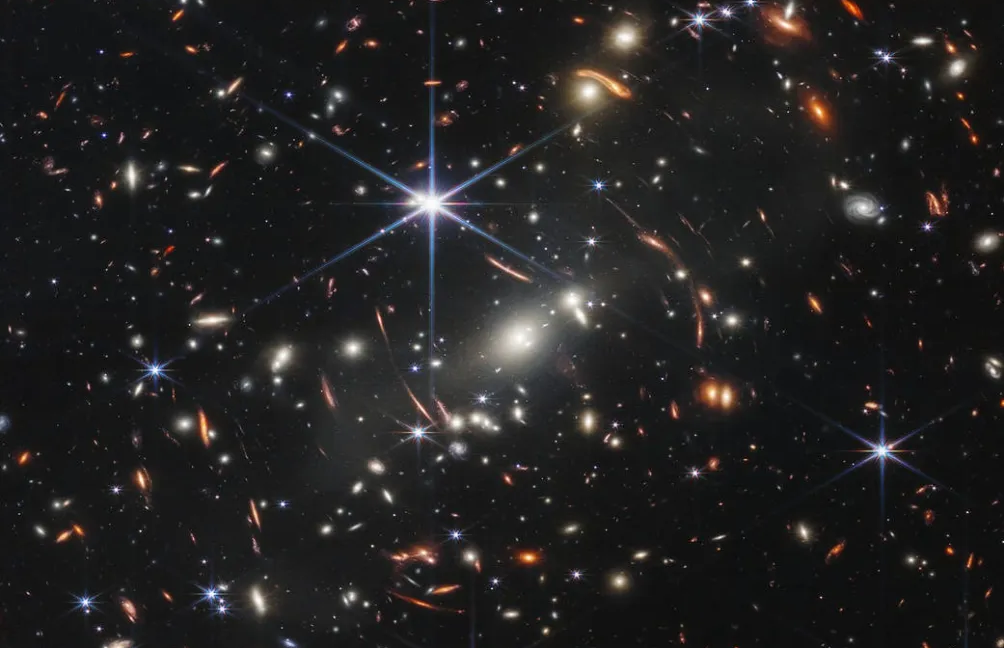
"The LAP1-B is 13 billion light-years away from Earth. To observe an object that faint and distant, even the huge, gold-coated beryllium mirrors of JWST were not enough on their own. We spotted it due to a massive cluster of galaxies called the MACS J046, which warps the spacetime between us and the LAP1-B."
""The galaxy was strongly magnified through the gravitational lensing effect," Nakajima said. Specifically, the spacetime warped by the MACS J046 clusters magnifies light traveling from LAP1-B toward Earth by roughly 100-fold."
"But even with this 100-fold boost in brightness, LAP1-B is so dim that neither the JWST nor Hubble could detect its stellar continuum-the steady background light of its stars. For Nakajima and his colleagues, though, even that worked as a clue. Knowing the distance separating us from the LAP1-B and the sensitivity of telescopes, they calculated that the hard upper limit of the stellar mass of LAP1-B must be equal to 3,300 Suns."
An ultra-faint galaxy, LAP1-B, was observed about 800 million years after the Big Bang using the James Webb Space Telescope. The galaxy lies roughly 13 billion light-years away and was detected through gravitational lensing by the galaxy cluster MACS J046, which magnified its light by about 100 times. Even with this boost, the stellar continuum was too faint for detection, so the stellar mass was constrained by telescope sensitivity and distance to an upper limit of about 3,300 solar masses. The observed light indicates that the galaxy’s emission is dominated by processes other than direct starlight, enabling study of its chemical primitiveness and early enrichment by the Universe’s first supernovae.
#james-webb-space-telescope #gravitational-lensing #early-galaxies #chemical-evolution #supernova-enrichment
Read at Ars Technica
Unable to calculate read time
Collection
[
|
...
]