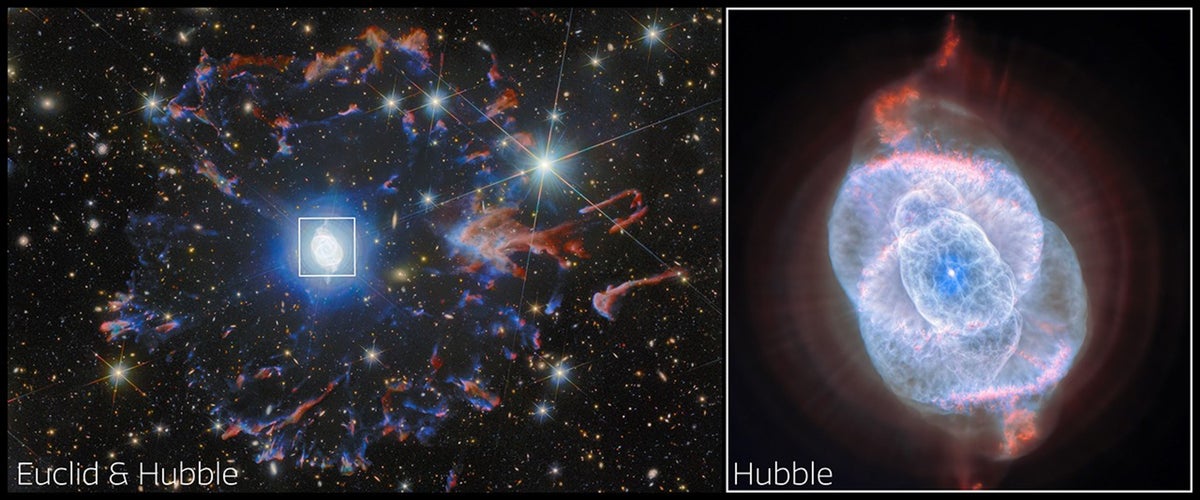
"The combined observations reveal the remarkable complexity of stellar death in this object. The data reveal a tapestry of concentric shells, jets of high-speed gas and dense knots sculpted by shock interactions, features that appear almost surreal in their intricacy."
"The images capture a wider view of the nebula, highlighting a ring of material radiating from its center. Incredibly, this halo may have been expelled from the system before the rest of the nebula formed."
The Hubble Space Telescope and Euclid space telescope combined observations to capture new images of the Cat's Eye Nebula, a dying star system located 4,400 light-years from Earth. These observations reveal far greater detail than Hubble's original 1995 images, showing a wider view with a ring of material radiating from the nebula's center that may have been expelled before the rest of the nebula formed. The data display concentric shells, high-speed gas jets, and dense knots sculpted by shock interactions. These findings demonstrate the remarkable complexity of stellar death and may provide insights into how planetary nebulae form and evolve.
Read at www.scientificamerican.com
Unable to calculate read time
Collection
[
|
...
]