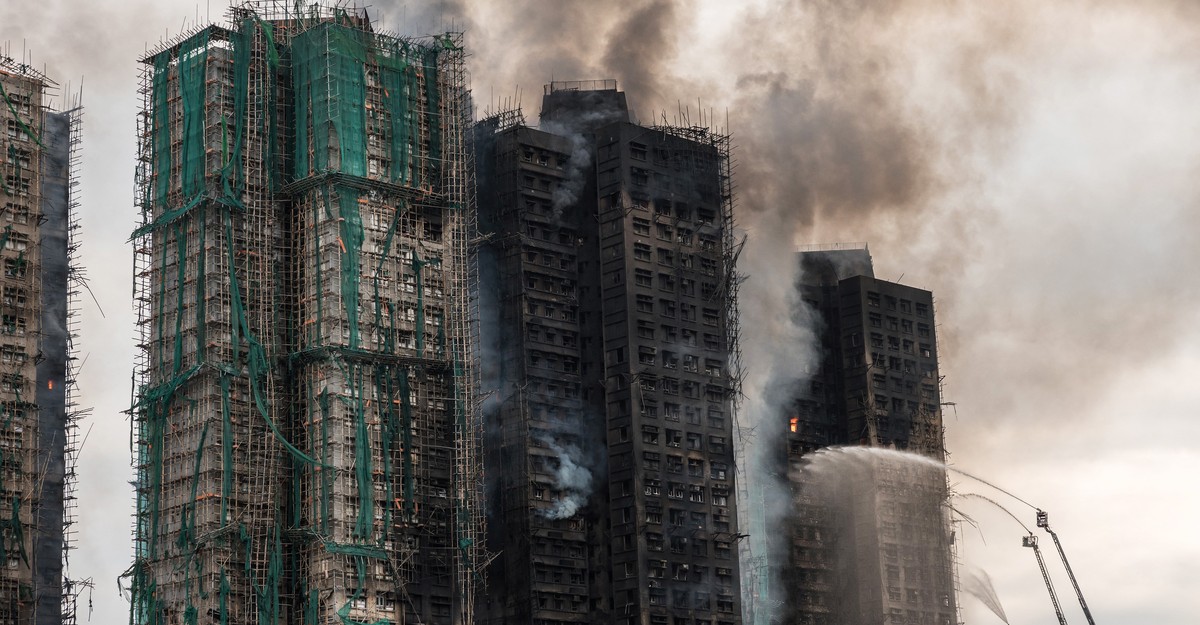
"The world's deadliest residential fire in more than four decades was still burning up a block of Hong Kong apartment buildings when pundits settled on a culprit: bamboo. Surely, the bamboo scaffolding that had surrounded the Wang Fuk Court towers explained how the flames tore through the complex so quickly. "There can be only one outcome," the Independent declared. "The bamboo has to go." But the disaster, which killed at least 160 people, reflects problems much more profound than the choice of scaffolding."
"These problems first took root as China prepared to assume control of Hong Kong from Britain, in 1997. Concerned that the transition would scare off foreign investors, Chinese leaders tried to woo real-estate tycoons and other business elites by giving them key roles overseeing the city's future governance. Beijing then propped up this new ruling class as a bulwark against efforts to further democratize the territory."
"The nexus between Hong Kong's government and Big Business gave rise to a real-estate market that served a select few elites rather than most residents. Limited supply and soaring costs precipitated a decades-long housing crisis, consigning roughly 220,000 Hong Kongers to subdivided apartments sometimes called "coffin homes," which can be smaller than a parking space. Meanwhile, the market delivered increasing returns to the city's elite. Of the 16 Hong Kongers listed in the Bloomberg Billionaires Index, seven owe their family fortune to real estate."
Bamboo scaffolding was initially blamed for a deadly Hong Kong residential fire, but deeper systemic failures were central to the tragedy. The problems originated during the lead-up to the 1997 handover, when Chinese leaders empowered real-estate tycoons and business elites with governance roles to reassure investors and block democratization. The close alliance between government and big business produced a property market serving elites, causing limited supply, soaring prices, and a long housing crisis. Approximately 220,000 people live in subdivided "coffin homes." Regulatory deference allowed corruption and corner-cutting in construction and renovations.
#hong-kong-housing-crisis #real-estate-oligarchy #regulatory-failure #subdivided-apartments #post-handover-governance
Read at The Atlantic
Unable to calculate read time
Collection
[
|
...
]