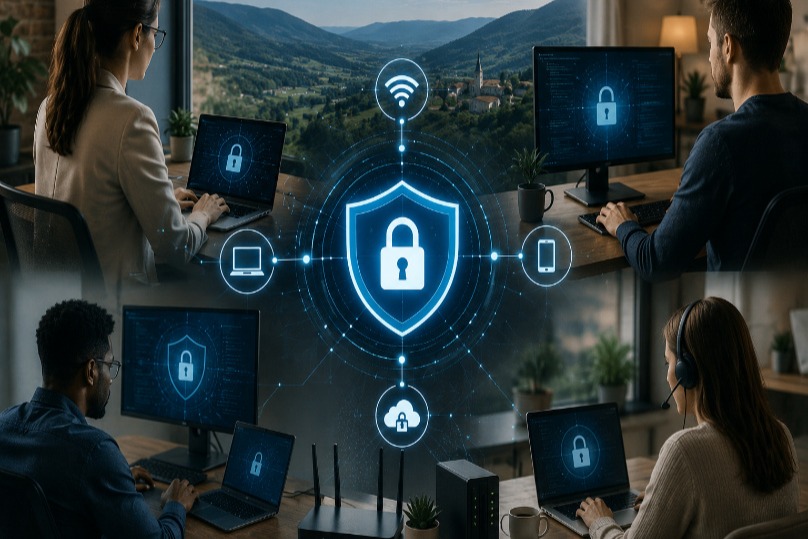
Hybrid work becomes the operating model for professional services, healthcare practices, and small business teams, bringing flexibility alongside security challenges. Office-only security relied on physical and network controls and a stable perimeter, but hybrid work removes that perimeter because employees connect from home, the road, and other uncontrolled networks. Equipment and access paths that previously worked behind office firewalls now connect from coffee shops, home networks, and hotel rooms. Compliance frameworks built on controlled environments must expand to cover mobile and remote scenarios. Security protection must follow the user instead of the place, using zero trust principles, identity-based and device-based trust signals, and stronger endpoint and identity protection supported by modern tools and managed expertise.
"Hybrid work has become the operating model for most Shenandoah Valley professional services firms, healthcare practices, and small business teams. The flexibility benefits are real but the security challenges are real too. Office-only environments enforced security through physical and network controls that simply do not exist when employees split time between office, home, and the road. The protection model has to follow the user instead of the place."
"The transition catches many businesses unprepared. Equipment that worked behind office firewalls now connects from coffee shops, home networks, and hotel rooms. Compliance frameworks that assumed users worked from controlled environments now have to address mobile and remote scenarios. The risk calculus shifts in ways that legacy security tools were never designed to address."
"Hybrid work breaks the network perimeter security model that office-only environments relied on for years. The network perimeter dissolves. Office-only environments protected data by controlling network access through firewalls and physical entry. Hybrid work eliminates this perimeter because users connect from anywhere on networks the business does not control. Strong network security for hybrid teams shifts protection from the network to the user and device."
"Zero trust architecture replaces network-based trust with identity-based and device-based trust signals. Endpoint security and identity protection matter more than network firewalls for hybrid teams. Strong protection for hybrid teams requires ongoing tuning as user behavior and threats evolve. A managed partner with hybrid security expertise reduces both implementation effort and ongoing risk."
#hybrid-work-security #zero-trust #endpoint-security #identity-protection #managed-security-services
Read at TalkMarkets
Unable to calculate read time
Collection
[
|
...
]