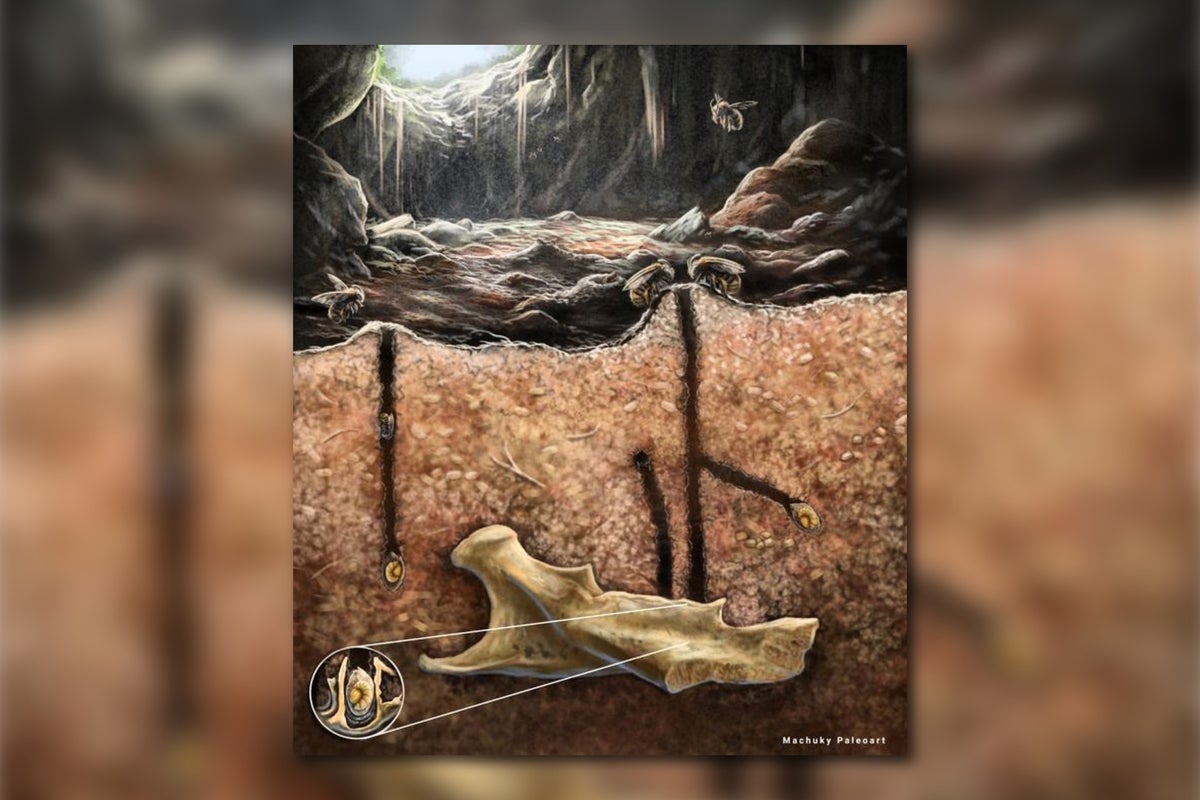
"Thousands of years ago in what is now the Dominican Republic, there was a cave full of bones. And those bones were full of bees. In a paleontological first, researchers have discovered that bees used the jawbones of now extinct mammals as burrows. It's not clear what species of bee was exploiting this grisly opportunityonly their smooth-walled nests were left behind, nestled in the tooth pockets of ancient rodents and sloths."
"When Vinola Lopez and his colleagues climbed past the jagged entrance of the cave, called Cueva de Mono, they were on the hunt for fossilized lizards, which they foundin excess. They also found tens of thousands of bones of extinct rodents and sloths, leading them to conclude that they'd stumbled upon the killing field of an ancient family of owls"
"Within the dirt filling the empty tooth sockets of both the rodent and sloth jawbones, Vinola Lopez and his colleagues noticed strange, smooth cuplike structures they eventually realized they were made by bees. The hard, smooth walls were the result of a waterproof layer that solitary bees add to their brood cells, where the insects' larvae develop."
A cave in what is now the Dominican Republic, Cueva de Mono, contained tens of thousands of bones including extinct rodents, sloths and abundant fossilized lizards. Empty tooth sockets in rodent and sloth jawbones preserved smooth, cup-like structures that match the waterproof brood-cell linings created by solitary bees. The nests occupied tooth pockets and produced hard, smooth walls from a waterproof layer applied by the bees. The fossils date to the late Quaternary, including species that went extinct more than 4,500 years ago. An accumulation of bones suggests an ancient owl nesting site and regurgitation of prey remains in the cave.
Read at www.scientificamerican.com
Unable to calculate read time
Collection
[
|
...
]