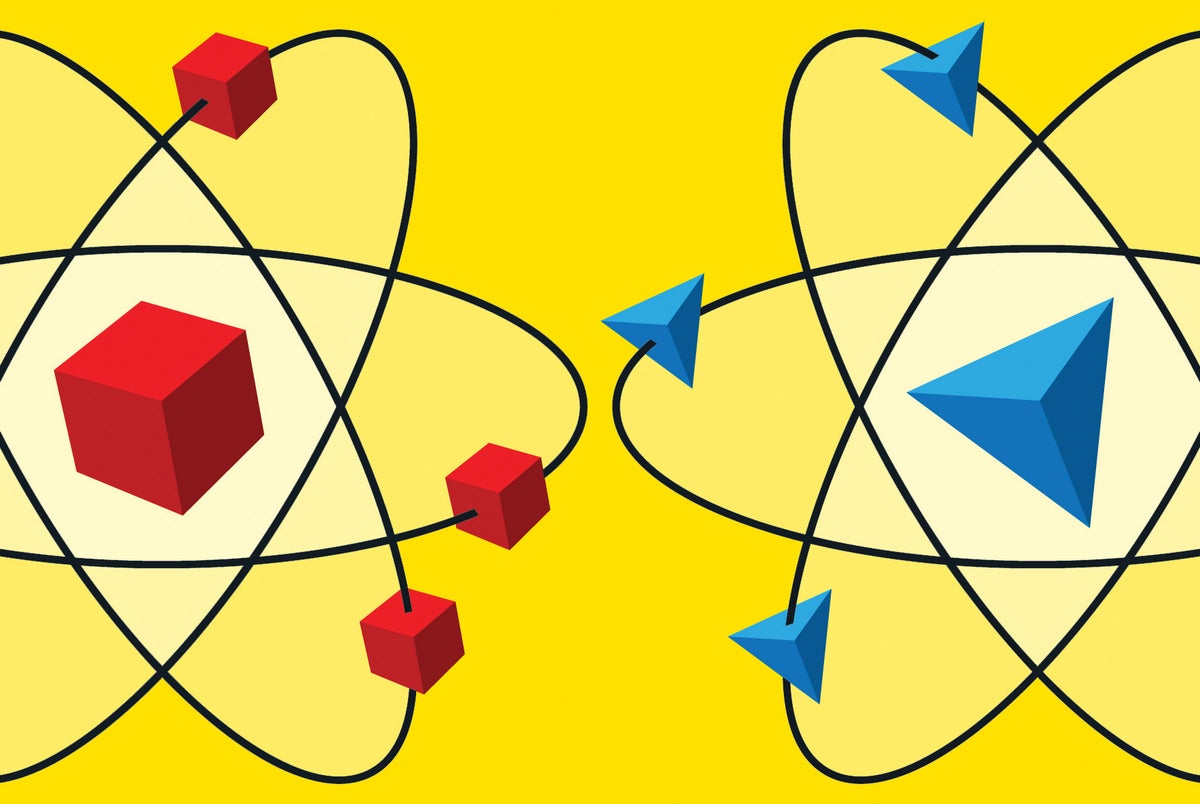
"One of physicists' foundational assumptions is that atoms aren't uniqueif two atoms have the same number of protons, neutrons and electrons, they will look and act exactly alike. This belief is fundamental to our understanding of physics and matter in the universe, and it paves the way for fields that rely on predictability, such as quantum computing. Atoms' indistinguishability is still just an assumption, however, and scientists have a plan to put it to the test."
"We like to have theory and experiment march together, Raizen says. This question has never been tested experimentally before, so that's what, to me, makes it interesting. If atoms were distinguishable, looking at two atoms of the same type would be like looking at two cars of the same make and model, says Christian Sanner, a physicist at Colorado State University, who was not involved in the new paper."
"Straight off the assembly line, they might seem impossible to tell apart. But if you move closer to precisely measure the tightness of the bolts and the tiny gaps between the doors and the frame, slight differences will become more apparent. To get extremely precise atomic measurements, Raizen proposes an experiment using a laser to cool and trap individual isotopesvariants of atomsin an extremely precise atomic clock."
"This setup would let researchers detect minute differences in the isotopes' energy levels by examining nuances in the magnetic field created by each particle's spinning nucleus, called the"
Atoms are commonly treated as indistinguishable when they share the same numbers of protons, neutrons, and electrons, enabling predictable models of matter and supporting technologies such as quantum computing. This indistinguishability remains an assumption rather than a confirmed experimental fact. A proposed experimental program uses laser cooling and trapping of individual isotopes in an extremely precise atomic clock. The goal is to detect minute differences in isotope energy levels by measuring how each spinning nucleus affects the magnetic field. By examining subtle variations in nuclear spin-related magnetic behavior, researchers could reveal whether nominally identical atoms behave exactly the same or show detectable deviations.
#atomic-indistinguishability #isotopes #laser-cooling-and-trapping #atomic-clocks #quantum-computing
Read at www.scientificamerican.com
Unable to calculate read time
Collection
[
|
...
]