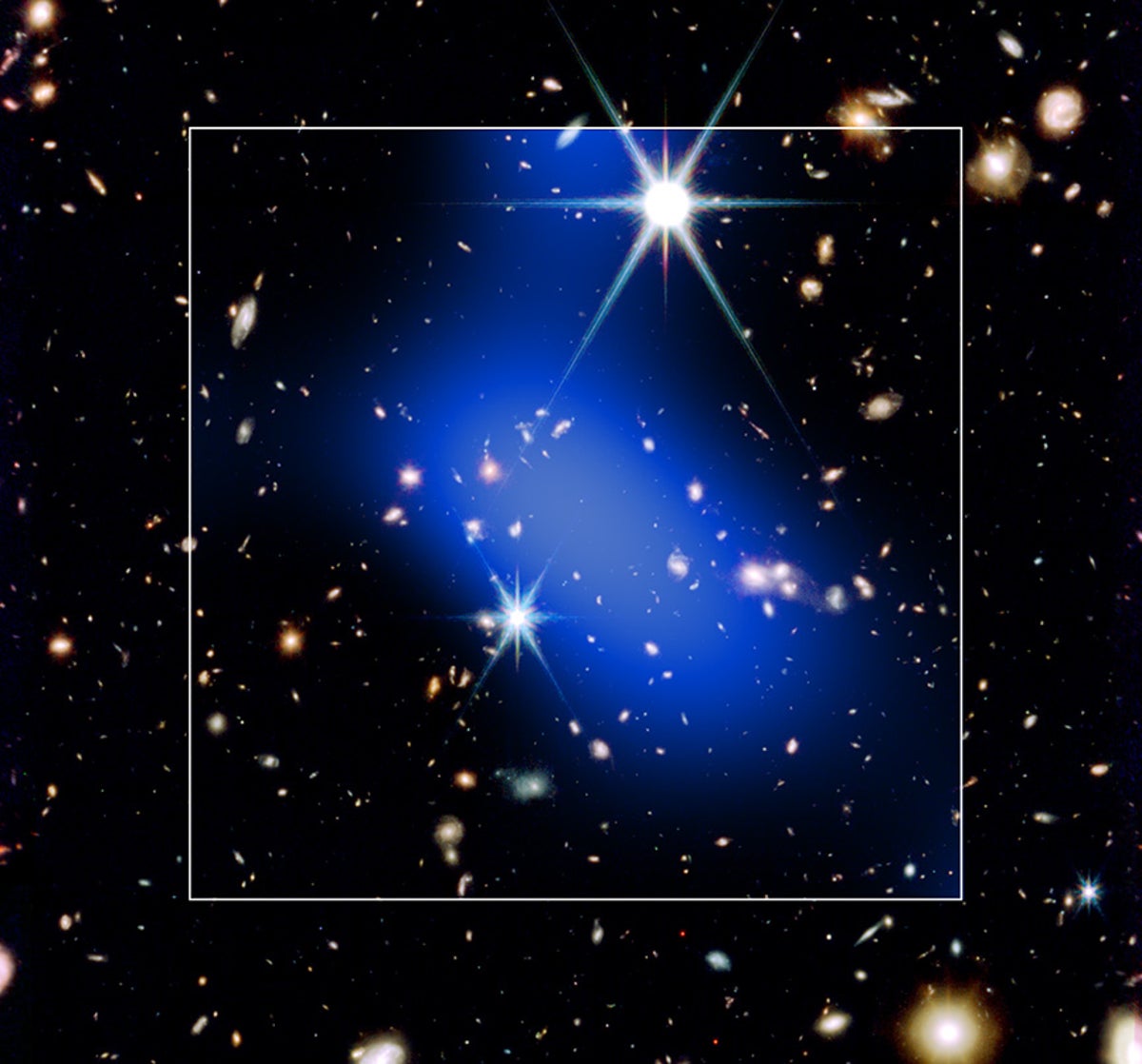
"Astronomers have spotted a mysteriously mature baby cluster of galaxies in the early universe, scarcely a billion years after the big bang. Although not a full-grown, full-blown galaxy cluster, the protocluster is still bigger and more developmentally advanced than most models can easily explainand also may be the most distant ever seen. Unveiled using NASA's Chandra X-ray Observatory and James Webb Space Telescope (JWST), the protocluster's strange stature was announced last week in a study published in Nature."
"Clusters of galaxies are often referred to as at the crossroads' between astrophysics and cosmology, says Elena Rasia, an astrophysicist at the University of Michigan, who was not part of the work. They're natural laboratories for studying how galaxies interact and how supermassive black holes grow. Tracking how clusters assemble across vast stretches of time and space also informs our knowledge of the cosmic web and the cosmological parameters that shape it."
"This so-far-unique protocluster, Rasia says, could be important from both perspectives. Called JADES-ID1 for its location within the JWST Advanced Deep Extragalactic Survey (JADES), the protocluster was first reported alongside about two dozen other early-universe candidate objects in a separate study published last year. JWST data suggest JADES-ID1 contains at least 66 young galaxies, and this latest study measures the protocluster as being some 20 trillion times more massive than our solar system."
Protocluster JADES-ID1 exists scarcely a billion years after the Big Bang and contains at least 66 young galaxies. The structure measures roughly 20 trillion times the mass of the solar system, with most mass in invisible dark matter. Chandra observations reveal an enormous cloud of hot, X‑ray–emitting gas enveloping the protocluster. The system appears more developmentally advanced and larger than standard formation models predict and may be the most distant protocluster yet observed. Such massive early structures constrain how galaxies interact, how supermassive black holes grow, and how the cosmic web and cosmological parameters shape large-scale structure.
Read at www.scientificamerican.com
Unable to calculate read time
Collection
[
|
...
]