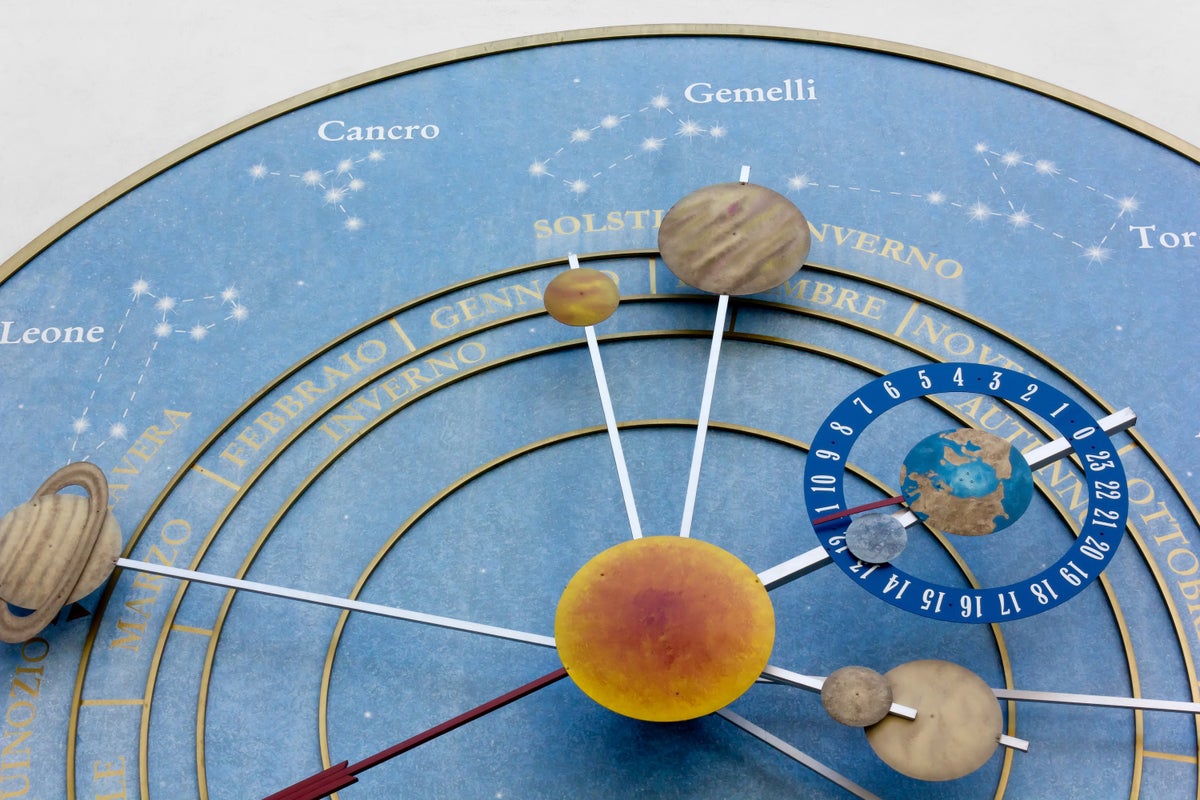
"It also spins on its axiscompleting one Mars dayin 24 hours, 39 minutes and 35 seconds (to distinguish this period from an Earth day, we call it a sol, referencing the Latin word for the sun). Keeping track of your schedule on Mars would be different than doing so on Earth. But still, at its core, it would just be a matter of conversion."
"Building an accurate Martian clock, on the other hand, can be very tricky, depending on how accurate you want it to be. When you start to slice time into smaller and smaller bits, the problem concerns not only engineering but also fundamental physics. That's because the flow of time on milli- and microsecond scales is affected by relativity, gravity and orbital mechanics, which can vary radically from world to world."
Martian chronometry differs from Earth's because a sol equals 24 hours, 39 minutes and 35 seconds and a Martian year spans about 687 Earth days, complicating calendar coordination. Achieving microsecond-level accuracy requires accounting for relativistic effects, gravitational potential differences, and orbital mechanics, which alter the flow of time at small scales. Building highly precise Martian clocks therefore involves both engineering and fundamental physics. Mathematical formulas and relativistic corrections tailored to Mars enable synchronization and fine-tuning of timepieces on the planet. Time’s nonabsolute nature under relativity becomes practically important for high-precision timekeeping on Mars.
Read at www.scientificamerican.com
Unable to calculate read time
Collection
[
|
...
]