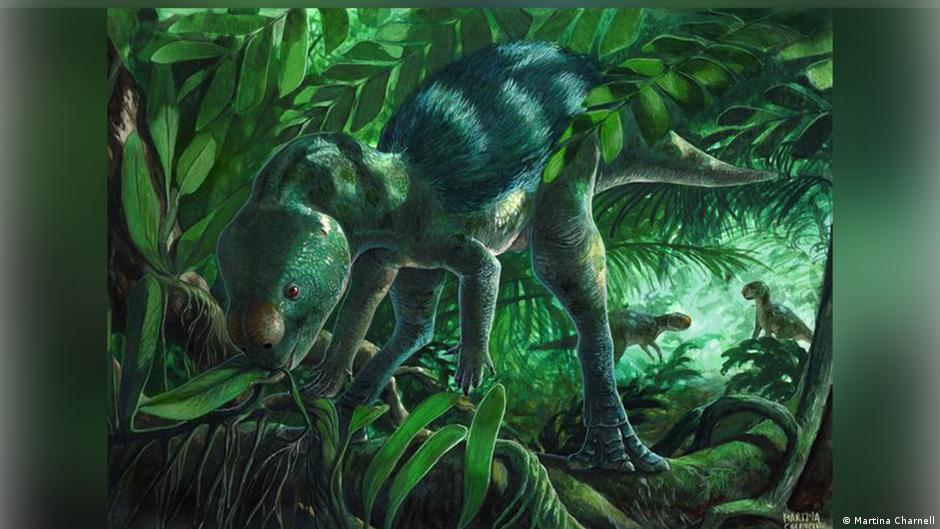
"Fidel Torcida Fernandez-Baldor from the Dinosaur Museum of Salas de los Infantes in northern Spain discovered the fossils, which together represent at least five individual dinosaurs. The musuem focuses on Cretaceous-era fossils. "From the beginning, we knew these bones were exceptional because of their minute size. It is equally impressive how the study of this animal overturns global ideas on ornithopod dinosaur evolution," he said in a press release from the Vrije Universiteit in Brussels, which contributed to the study."
"Fossils of the newly discovered "Foskeia pelendonum" show the dinosaur measured just over half a meter in length, or just under 20 inches. The name Foskeia in Greek, from which many dinosaur names are derived, means something close to "light foraging," according to Vrije Universiteit. "This is not a 'mini Iguanodon', it is something fundamentally different ... Its anatomy is weird in precisely the kind of way that rewrites evolutionary trees," said Penelope Cruzado-Caballero from Universidad de La Laguna in Spain."
Fossils found in northern Spain represent at least five individual dinosaurs and were discovered by Fidel Torcida Fernandez-Baldor of the Dinosaur Museum of Salas de los Infantes. The museum focuses on Cretaceous-era fossils. The remains belong to a tiny ornithopod named Foskeia pelendonum, measuring just over half a meter. The name means roughly "light foraging" in Greek. Researchers note the skull shows unexpected complexity and hyper-derived features despite miniaturization. Paleontologists say Foskeia's anatomy differs radically from larger ornithopods and helps fill a 70-million-year gap, potentially altering ornithopod evolutionary trees.
Read at www.dw.com
Unable to calculate read time
Collection
[
|
...
]