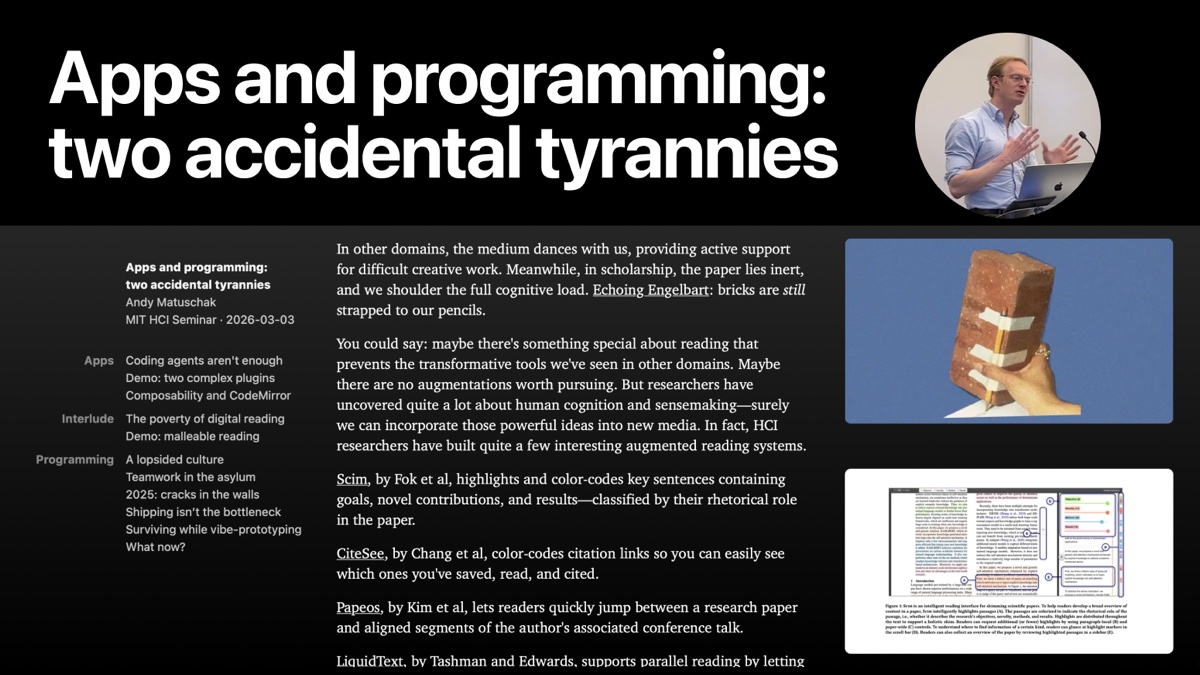
"Agents can make one-off apps, but they're usually toys. I show how we might bring malleability and composability to the kind of deep interfaces that experts live in all day-demonstrated in a writing environment, but applicable to all serious software. Little serious reading software exists, so I propose and demonstrate a new kind of malleable digital reading environment focused on expert use."
"But malleable interfaces aren't enough. Historically, inventing interfaces has required imaginative design skill, deep domain insight, and fluent programming. Few have all three, but programming is the only skill that can produce working software on its own-so interface invention culture is dominated by programmers. I share early reports of how coding agents are changing that, and what it might mean for the people and institutions inventing interfaces today."
"We can follow a chain of thought beyond our working memory. We can think abstractly and analytically. We can build on ideas of people we've never met, and leave our own for posterity. But it wasn't natural selection that gave us those abilities. It was other people. We've inherited that astounding power to create tools which shape our own thoughts-the power to transcend our own mental capabilities."
"Written language was the work of whole cultures. But what excites me most in my work is that small groups and even individuals can also invent transformative tools for thought. I think of Playfair and statistical graphics in the eighteenth century, or Mendeleev an"
Coding agents can help escape two constraints: rigid app silos and programming specialization that crowds out imagination and domain insight. Agents can build one-off apps, but they often remain limited. A malleable, composable interface approach can support deep expert workflows, demonstrated through a writing environment and proposed for broader serious software. Interface invention historically required imaginative design skill, domain expertise, and fluent programming, but programming dominates because it alone reliably produces working software. Coding agents can shift this balance by enabling more people and institutions to invent interfaces. Tool-making can transcend individual mental limits, and transformative tools for thought can be created by small groups or individuals, not only whole cultures.
Read at Andymatuschak
Unable to calculate read time
Collection
[
|
...
]