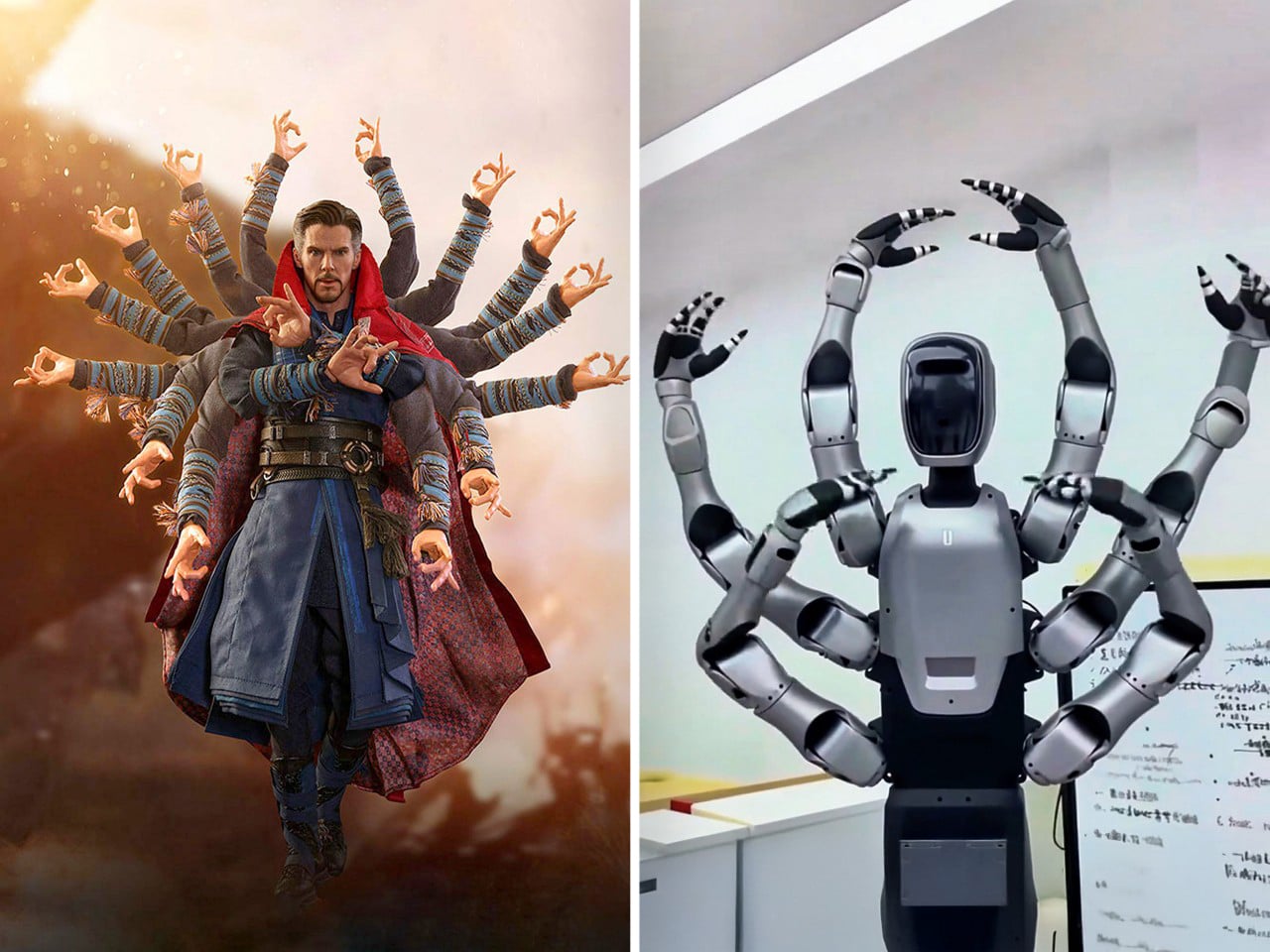
"Midea's new Miro U looks like someone freeze framed that shot, printed it, and walked it down the hall to the robotics lab with the caption "do this, but for factories." Six coordinated arms, a torso that feels almost cloaked, a wheeled base that spins 360 degrees in place, it reads less like industrial equipment and more like a concept sheet that escaped ArtStation."
"Miro U trades the prestige of bipedal walking for a wheel leg base that is brutally honest about factory floors. No stairs, no urban parkour, just flat concrete and tight aisles that reward stability and turning radius over photogenic gait. It also trades the polite two arm humanoid silhouette for six bionic arms that Midea describes as high precision and flexibly controlled, coordinated around a central spine like a mechanical mandala."
"There is a design honesty here that I find refreshing. Most humanoid projects in the West are in a beauty contest with the human form. Smooth faces, leggy proportions, carefully choreographed walking demos, everything framed around the idea that "this could stand where a worker stands." Miro U walks away from that stage and heads for the backstage rigging. Six arms mean it behaves less like a single worker and more like a compact crew."
Miro U combines a wheeled 360-degree base with six coordinated arms around a central spine, prioritizing stability and parallel manipulation over humanoid walking. The platform sacrifices bipedal mobility to favor turning radius and reliability on flat factory floors and in tight aisles. The six arms enable simultaneous grabbing of tools, fixtures, and parts, functioning like a compact crew to accelerate line changeovers and modular cell operations. Midea targets roughly a 30 percent improvement in line changeover efficiency at a washing machine plant deployment. The design emphasizes functional honesty rather than human likeness.
Read at Yanko Design - Modern Industrial Design News
Unable to calculate read time
Collection
[
|
...
]