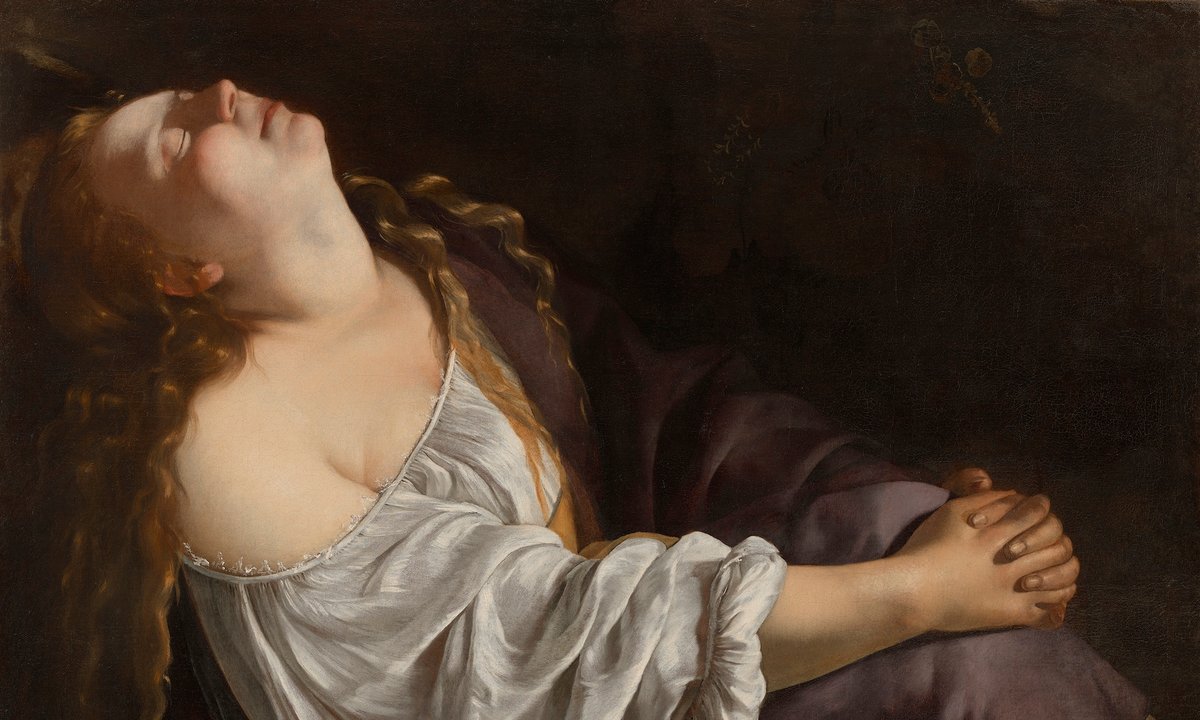
"The painting depicts the titular saint, her face turned upward, "going through the throes of change from a secular life to one of devotion", says the curator. Shown without her usual attributes of a skull or an ointment jar, or any other signs of penitence, Mary Magdalene is instead depicted in a state of near undress, a shoulder provocatively exposed."
"Though produced around three decades before Gian Lorenzo Bernini's 1652 sculptural altarpiece, The Ecstasy of St Teresa, which theatrically fuses sexual pleasure with religious transformation, Mary Magdalene in Ecstasy might also simultaneously suggest the erotic and the spiritual, says Straussman-Pflanzer. Even before Bernini's revolutionary work, she says, the 17th-century Catholic imagination did not regard the two at cross purposes, as we might."
Mary Magdalene in Ecstasy (c.1625) has entered the National Gallery of Art collection in Washington, DC. Artemisia Gentileschi painted the work during her second Roman period (c.1620–1626/27), when she worked without a workshop and produced some of her strongest works. The painting shows Mary Magdalene with her face turned upward, transitioning from secular life to devotion, shown without traditional penitential attributes and nearly undressed with an exposed shoulder. The composition suggests an intertwining of eroticism and spirituality that anticipates Bernini's The Ecstasy of St Teresa.
Read at The Art Newspaper - International art news and events
Unable to calculate read time
Collection
[
|
...
]