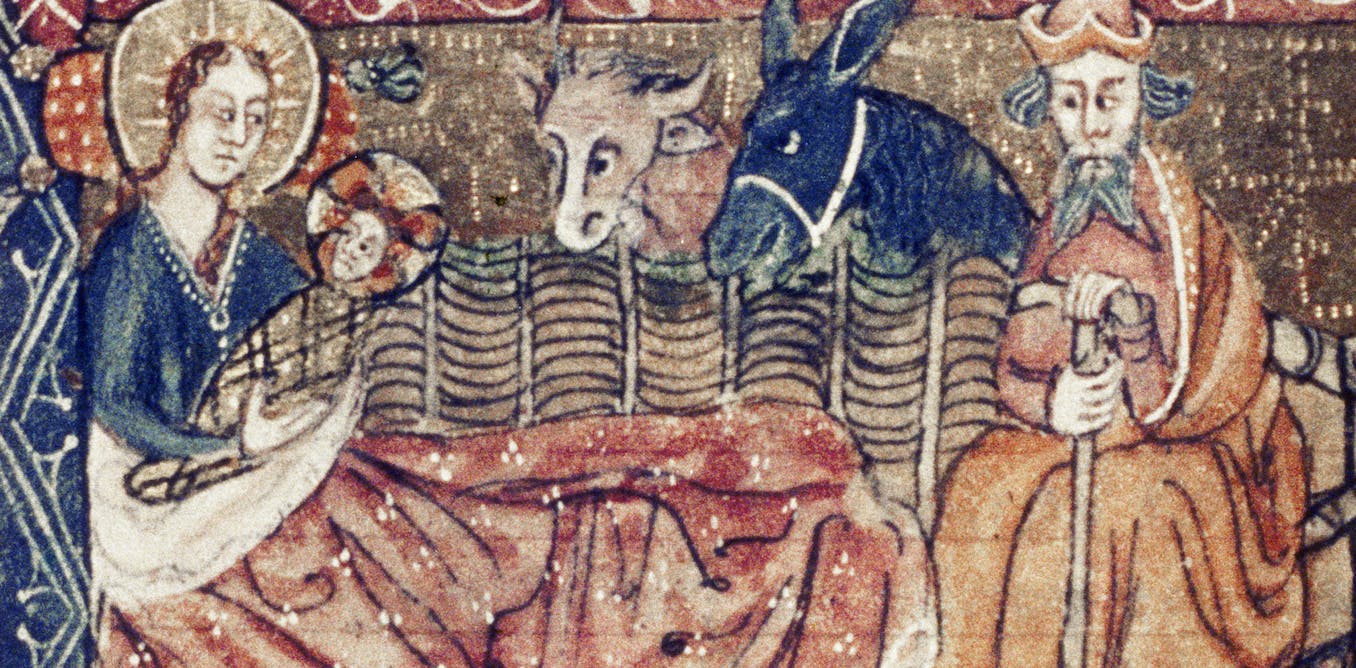
"Manger scenes displayed around Christmastime usually feature an ox and an ass beside the infant Jesus. According to the Gospel of Luke, Mary placed her child in a manger - an animal feeding bin - "because there was no room for them in the inn." No mere babysitters, the ox and ass harken back to the Book of Isaiah 1:3, a verse early Christians interpreted as a prophecy of the birth of Christ."
"The canonical Gospels, the accounts of Jesus' life included in the Bible's New Testament, make no mention of those animals welcoming the newborn. Yet the motif was already seen in art from the fourth century. It was further popularized by the Gospel of Pseudo-Matthew, an apocryphal text - that is, one not included in the canon of Scripture. Pseudo-Matthew was composed by an anonymous monk, probably in the seventh century, and includes many tales about Jesus growing up."
Nativity imagery commonly shows an ox and an ass beside the infant Jesus because Mary placed him in a manger, a feeding trough, after finding no room in the inn. Early Christians linked these animals to Isaiah 1:3 and sometimes depicted them kneeling in reverence to the swaddled child. The canonical Gospels do not name these animals, but the motif appears in fourth-century art and was popularized by the apocryphal Gospel of Pseudo-Matthew, composed by an anonymous monk around the seventh century. Numerous apocryphal legends about Jesus' childhood circulated widely in the Middle Ages. The Bible records the temple episode when 12-year-old Jesus conversed with teachers, famously portrayed by Simone Martini.
Read at The Conversation
Unable to calculate read time
Collection
[
|
...
]