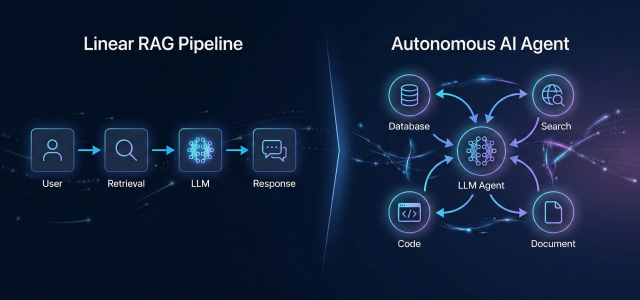
"The jump from "RAG application" to " AI agent " can feel dramatic. New SDKs, new abstractions, new architecture diagrams. But in practice, many agentic systems are not reinventions - they're evolutions. The difference between a retrieval-augmented pipeline and an AI agent is often not a rewrite, but a series of small architectural decisions that gradually introduce autonomy."
"If you already have a RAG pipeline in production, you may be closer to an agent than you think. The most productive mindset is not "replace everything," but "upgrade deliberately." At each stage, you keep a fully working system. What changes is who controls the flow: your code - or the model. And that incremental path is exactly what modern reasoning-capable LLMs were built to support."
"Every journey starts with a simple chat loop. A user message is appended to the conversation history, the model generates a response, and that response is stored for future turns. It's transparent, predictable, and easy to debug. But it's limited to what the model already knows. Ask it about a newly released document or post-cutoff data, and it either declines or guesses. This is where retrieval enters."
"Basic RAG improves factual grounding by retrieving relevant documents for every query. The user's question goes directly to a vector store or search layer. Retrieved snippets are appended to the context. The model answers using that additional information. This pattern works well when the user's question is self-contained and keyword-rich. However, it makes a strong assumption: retrieval is always useful. That assumption breaks quickly in real-world applications."
A simple chatbot loop appends user messages to conversation history, generates responses, and stores them for later turns, but it cannot reliably answer questions about new or post-cutoff information. Retrieval augments grounding by fetching relevant documents and appending retrieved snippets to the model’s context so answers can use external knowledge. Basic RAG retrieves for every query, which can fail when retrieval is not actually useful. Agentic RAG introduces autonomy by making retrieval conditional and by gradually changing who controls the flow, moving from deterministic code control toward model-driven decisions. Upgrading deliberately keeps a fully working system at each stage while modern reasoning-capable LLMs support incremental evolution toward agents.
Read at Medium
Unable to calculate read time
Collection
[
|
...
]