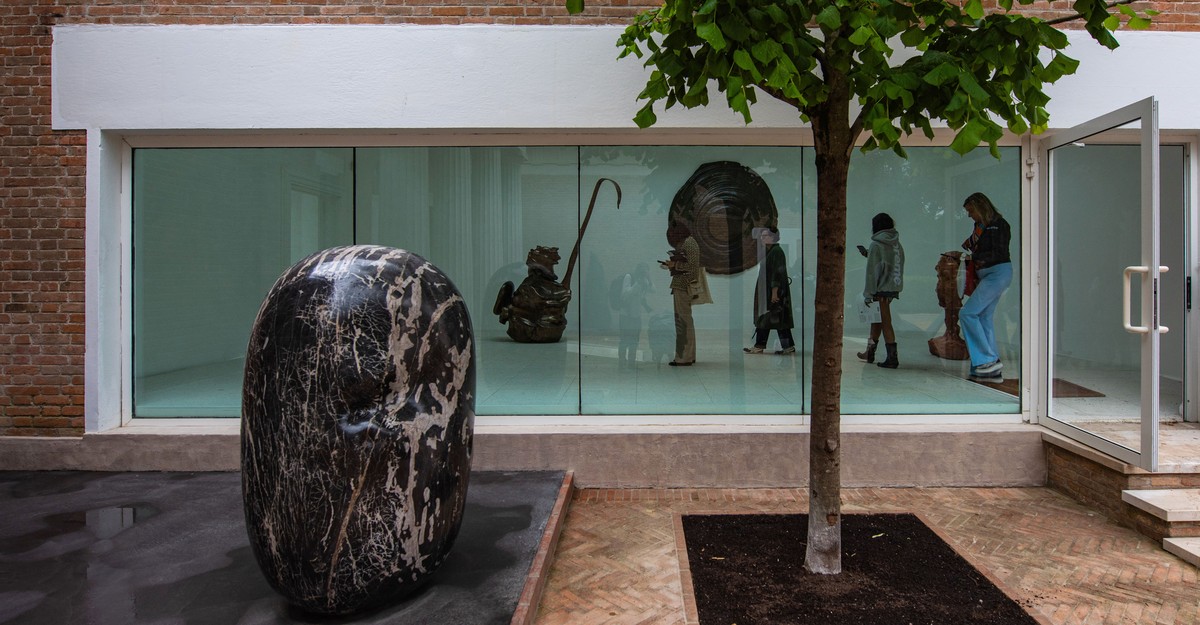
"Every two years, countries from around the world select an artist (or a group of artists) to showcase at contemporary art's most prestigious festival. This year, after a process laden with complication and controversy typical of the second Trump administration's cultural efforts, the United States picked the 55-year-old sculptor Alma Allen. He filled a series of rooms with quiet, abstract shapes, including an onyx boulder with a wavy surface, a folded sheet of scuffed bronze, and a standing oval of marshmallowish marble."
"We are at a critical moment in culture, wrote the pavilion's curator, Jeffrey Uslip. He was referring to America's 250th birthday, which inspired this exhibition that favors deep time, eschews finite positions, and encourages artistic autonomy and curatorial independence. According to Uslip, Allen makes allocentric art that provides the ground for 'the Allocene'-a proposal for art that embodies a state of alterity, weightlessness, and freedom of thought."
"The artist also described his own work: Here is cancellation deployed as a physical act, and here is the biggest risk of my life except for all the other ones. Gallery walls are hardly known for the quality of their copy, but this gobbledygook carried a passive-aggressive edge. Allocentric is the opposite of egocentric, and allocene is a made-up word suggesting a new epoch that-one imagines-deemphasizes identity and self-interest."
The United States Pavilion at the Venice Biennale featured sculptor Alma Allen, selected through a complicated and controversial process. The exhibition filled rooms with quiet, abstract forms, including an onyx boulder with a wavy surface, a folded sheet of scuffed bronze, and a standing oval of marshmallowish marble. The viewer’s initial reaction was uncertainty and a sense of lacking a clear emotional response. Confusion turned into annoyance after reading an exit plaque containing extensive artspeak. The curator framed the work around America’s 250th birthday and described concepts such as deep time, artistic autonomy, allocentric art, and a proposed “Allocene.” The language was perceived as pretentious and politically tinged, with terms like cancellation and curatorial independence carrying echoes of cultural conflict.
Read at The Atlantic
Unable to calculate read time
Collection
[
|
...
]