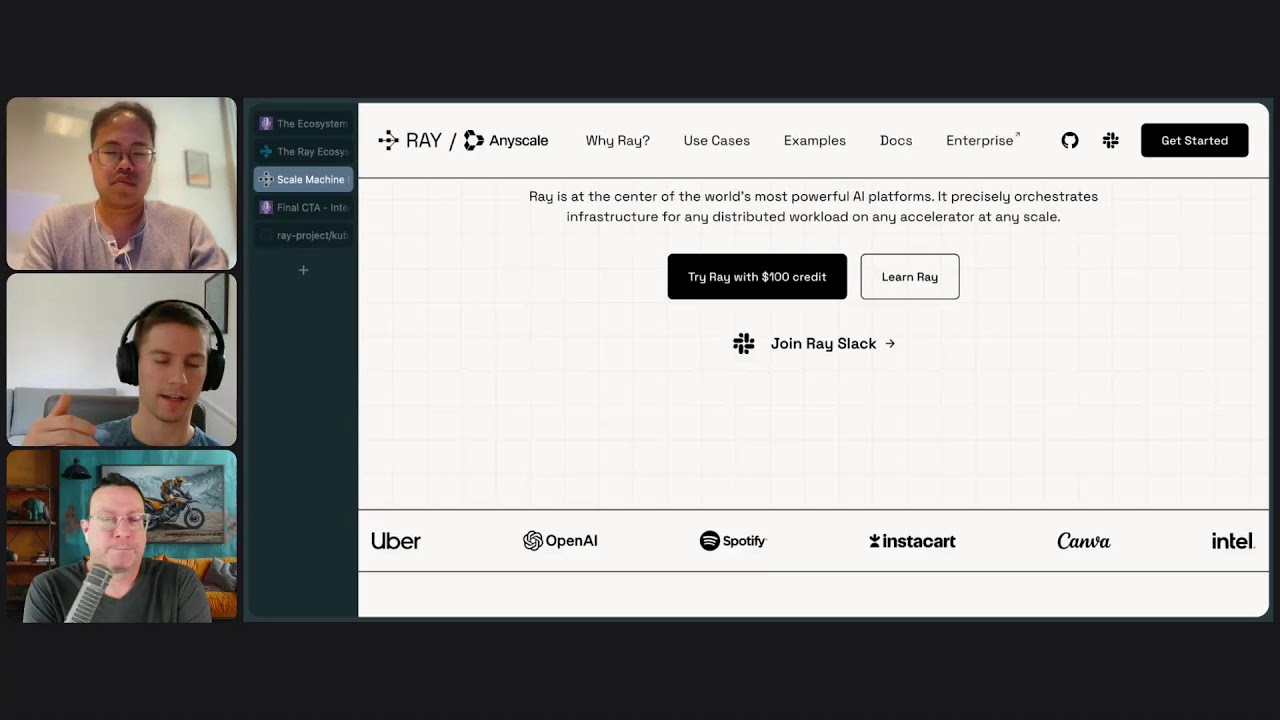
"Ray was originally built for reinforcement learning research, then quietly faded as RL hit a wall. Until ChatGPT showed up. Suddenly reinforcement learning was back, as the post-training step that turns a raw language model into something genuinely useful."
"Ray serves as a distributed execution engine for AI workloads, allowing a few lines of Python to run across hundreds of GPUs, making it easier for developers to scale their applications."
"Edward Oakes describes himself as an 'infrastructure and distributed computing person' rather than an AI specialist, motivated by building abstractions that let everyday Python developers tap into large-scale computing."
"Key features of Ray include Ray Data for multimodal pipelines, a dashboard, the VS Code remote debugger, and KubRay for Kubernetes, positioning it alongside Dask, multiprocessing, and asyncio."
Ray, an open-source Python framework, was developed for reinforcement learning but gained prominence with the rise of ChatGPT. It serves as a distributed execution engine for AI workloads, enabling Python developers to scale applications across multiple GPUs. Founding engineers Edward Oakes and Richard Liaw discuss Ray's evolution from its origins at UC Berkeley to its current role in powering large training runs. Key features include Ray Data for multimodal pipelines, a dashboard, and integration with Kubernetes through KubRay, making it a vital tool for developers seeking efficient scaling solutions.
Read at Talkpython
Unable to calculate read time
Collection
[
|
...
]