European startups
fromTechRepublic
8 hours agoUK and Europe Land 33% of New Startups Founded by DeepMind Alumni
112 DeepMind alumni launched startups since Q2 2025, with 28 in the UK and Europe, signaling strong AI-driven tech growth.
Ray was originally built for reinforcement learning research, then quietly faded as RL hit a wall. Until ChatGPT showed up. Suddenly reinforcement learning was back, as the post-training step that turns a raw language model into something genuinely useful.
That someone "should get out more" is usually said as a joke, a light comment aimed at someone who seems stuck or overly absorbed in a narrow concern. It can sound dismissive or even sarcastic. Yet what if it contains serious psychological truth? We often praise people for being open-minded, creative, or flexible, as if these are stable personality traits that some individuals simply possess. We admire those who seem to think differently and assume they have access to something rare.
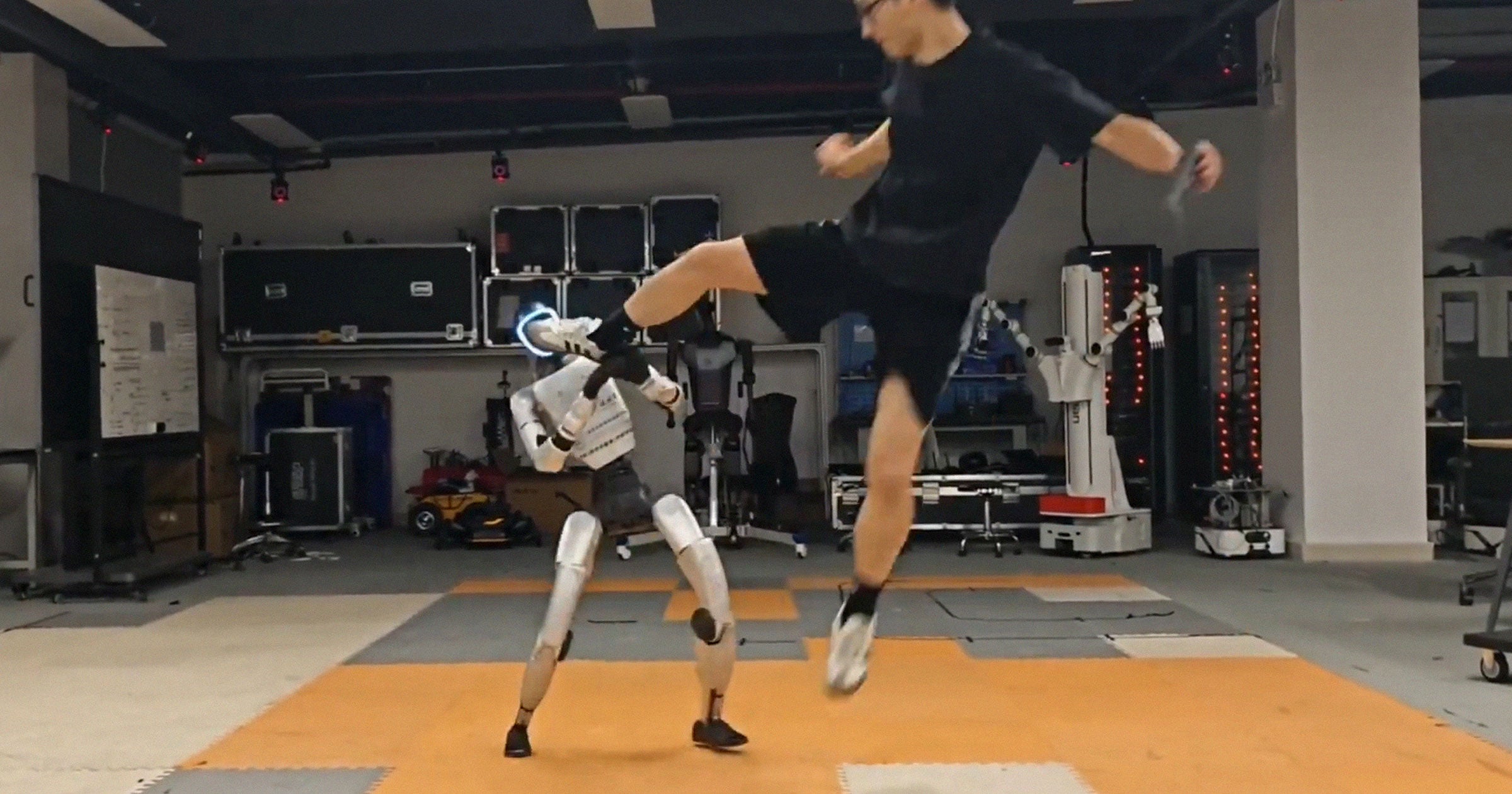
In footage circulating online, a Unitree G1 robot loses balance while performing in front of a crowd in China. As it hits the ground, it uncontrollably thrashes its limbs in all directions, hitting a man in the nose. The man, who appeared to be the robot's operator, had tried to grab the humanoid machine to stop it from tipping over. Later in the video, he can be seen squatting on the ground nursing a bleeding nose.
Ricursive Intelligence, a startup building an AI system to design and automatically improve AI chips, has raised $300 million at a $4 billion valuation. The company said Monday the round was led by Lightspeed. Ricursive says the system will be able to create its own silicon substrate layer and speed up AI chip improvements. Rinse and repeat to get to AGI, the founders say.
Generalist models "fail miserably" at the benchmarks used to measure how AI performs scientific tasks, Alex Zhavoronkov, Insilico's founder and CEO, told Fortune. " You test it five times at the same task, and you can see that it's so far from state of the art...It's basically worse than random. It's complete garbage." Far better are specialist AI models that are trained directly on chemistry or biology data.
Ever had a song stuck in your head long after the music stopped? Or found yourself replaying an argument-what you said, what you wish you had said, or how it might unfold next time? These mental loops aren't random; they're driven by a powerful feedback system in your brain. That's why catchy tunes stick and arguments replay in your head: Your brain isn't just being stubborn or "obsessed." It's looping with a purpose-like running practice drills.
Reinforcement learning (RL) is the next frontier, Google is surging, and the party scene has gotten completely out of hand. Those were the through lines from this year's NeurIPS in San Diego. NeurIPS, or the "Conference on Neural Information Processing Systems," started in 1987 as a purely academic affair. It has since ballooned alongside the hype around AI into a massive industry event where labs come to recruit and investors come to find the next wave of AI startups.
"Our latest Olaf is a fantastic example of representing an animated character as authentically as possible in the physical world-a challenging task because animated characters most often move in non-physical ways," Kyle Laughlin, senior vice president of Walt Disney Imagineering Research & Development, said in a news release . "For example, to make Olaf's snowball feet move along his body, we paired state-of-the-art deep reinforcement learning with an artistic interface and advances in mechanical design."
The Allen Institute for Artificial Intelligence has launched Olmo 3, an open-source language model family that offers researchers and developers comprehensive access to the entire model development process. Unlike earlier releases that provided only final weights, Olmo 3 includes checkpoints, training datasets, and tools for every stage of development, encompassing pretraining and post-training for reasoning, instruction following, and reinforcement learning.
A long-standing goal of artificial intelligence is to build systems capable of complex reasoning in vast domains, a task epitomized by mathematics with its boundless concepts and demand for rigorous proof. Recent AI systems, often reliant on human data, typically lack the formal verification necessary to guarantee correctness. By contrast, formal languages such as Lean1 offer an interactive environment that grounds reasoning, and reinforcement learning (RL) provides a mechanism for learning in such environments.
Meta's PyTorch team and Hugging Face have unveiled OpenEnv, an open-source initiative designed to standardize how developers create and share environments for AI agents. At its core is the OpenEnv Hub, a collaborative platform for building, testing, and deploying "agentic environments," secure sandboxes that specify the exact tools, APIs, and conditions an agent needs to perform a task safely, consistently, and at scale.
But reasoning models have changed the game, Midha said, referring to the new generation of AI systems designed to "reason"problems step by step, mimicking logic and reflection rather than predicting the next word in a sequence. These models can evaluate their own outputs better, break complex tasks into sub-tasks, and learn from feedback, potentially bringing AI closer to complex, real-world problem-solving.
A few months ago, I asked ChatGPT to recommend books by and about Hermann Joseph Muller, the Nobel Prize-winning geneticist who showed how X-rays can cause mutations. It dutifully gave me three titles. None existed. I asked again. Three more. Still wrong. By the third attempt, I had an epiphany: the system wasn't just mistaken, it was making things up.
At its core (dare I say heart), AI is a machine of probability. Word by word, it predicts what is most likely to come next. This continuation is dressed up as conversation, but it isn't cognition. It is a statistical trick that feels more and more like thought. Training reinforces the trick through what's called a loss function. But this isn't a pursuit of truth. It measures how well a sequence of words matches the patterns of human language.