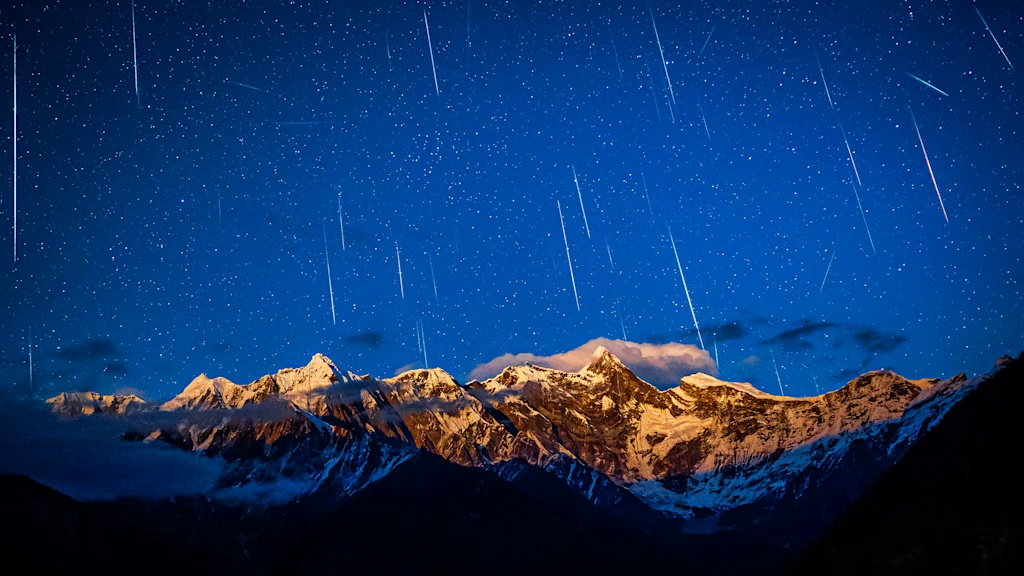
"These days, the Geminid meteor shower is considered by NASA to be "one of the best and most reliable annual meteor showers." The event started much smaller. The meteors were first observed in the mid-1800s and only boasted 10-20 meteors an hour. As time went on, Jupiter got in on the action. The planet's gravity pulled the show closer to Earth."
"It wasn't until the 1980s that scientists understood the cause of the meteor shower was asteroid 3200 Phaethon. Typically, meteor showers are caused by a comet. Asteroid 3200 Phaethon acts like a comet, despite most asteroids taking 1.4 years to fully orbit the sun. Scientists are still learning about this unique space object."
"A 2023 article, published in Planetary Science Journal by California Institute of Technology PhD student Qicheng Zhang, stated that when the asteroid approaches the sun, it forms a sodium-gas tail instead of dust. This challenges earlier beliefs about the object. It is now hypothesized that the dense Geminid meteoroids are a result of a possible past mass loss, not an ongoing tail shedding around the sun."
The Geminid meteor shower is active annually around December 1–21 and peaks the evenings of December 12 and 13. The meteors were first observed in the mid-1800s, initially producing only 10–20 meteors per hour, and later intensified as Jupiter's gravity shifted the stream closer to Earth. The shower's source is asteroid 3200 Phaethon, which behaves like a comet. Observations show Phaethon forms a sodium-gas tail near the sun rather than shedding dust, prompting a hypothesis that dense Geminid meteoroids originate from past mass loss. The meteoroids burn in Earth's atmosphere, producing vivid bursts best seen from the Northern Hemisphere.
Read at Fast Company
Unable to calculate read time
Collection
[
|
...
]