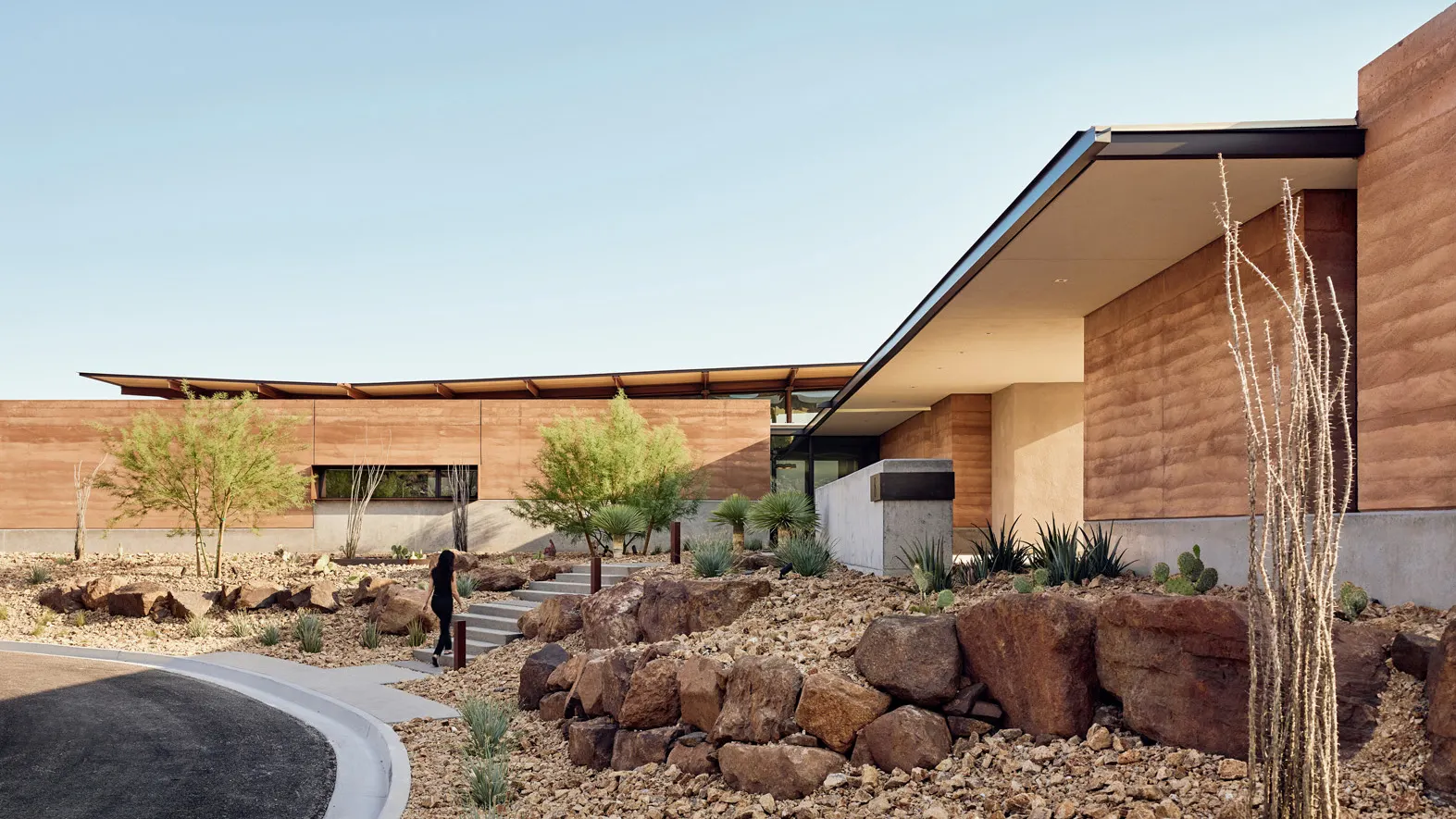
"It was widely used in ancient China, but appears globally throughout history, including in the U.S. After the industrial revolution, and the innovations of steel, concrete, glass, and mass-produced bricks, the traditional method fell out of favor. Now, however, an increasing number of architects are looking to the material as a sustainable, place-rooted way to build amid a climate crisis that calls for dramatically reduced carbon emissions."
"In the English countryside, a new project has emerged from the landscape-quite literally. Rammed Earth House, a residential estate by London-based Tuckey Design Studio, combines renovated brick buildings with new rammed earth structures, harnessing the clay soil of the very land it sits on. "The material is already under your feet, and it doesn't come with all the carbon baggage that other [building] materials come with," says studio founder Jonathan Tuckey."
Rammed Earth House pairs renovated brick buildings with new rammed earth structures that use clay soil excavated from the site. Rammed earth mixes local clay with aggregate and compresses it into layered walls, a technique used worldwide for millennia. The method avoids high-temperature firing and can incorporate demolition rubble as aggregate, dramatically reducing embodied carbon and transportation emissions. The material is repairable with simple local clay and biodegradable back into the ground, enabling circularity. Growing architectural interest in rammed earth responds to the need for place-rooted, lower-carbon construction solutions amid the climate crisis.
Read at Fast Company
Unable to calculate read time
Collection
[
|
...
]