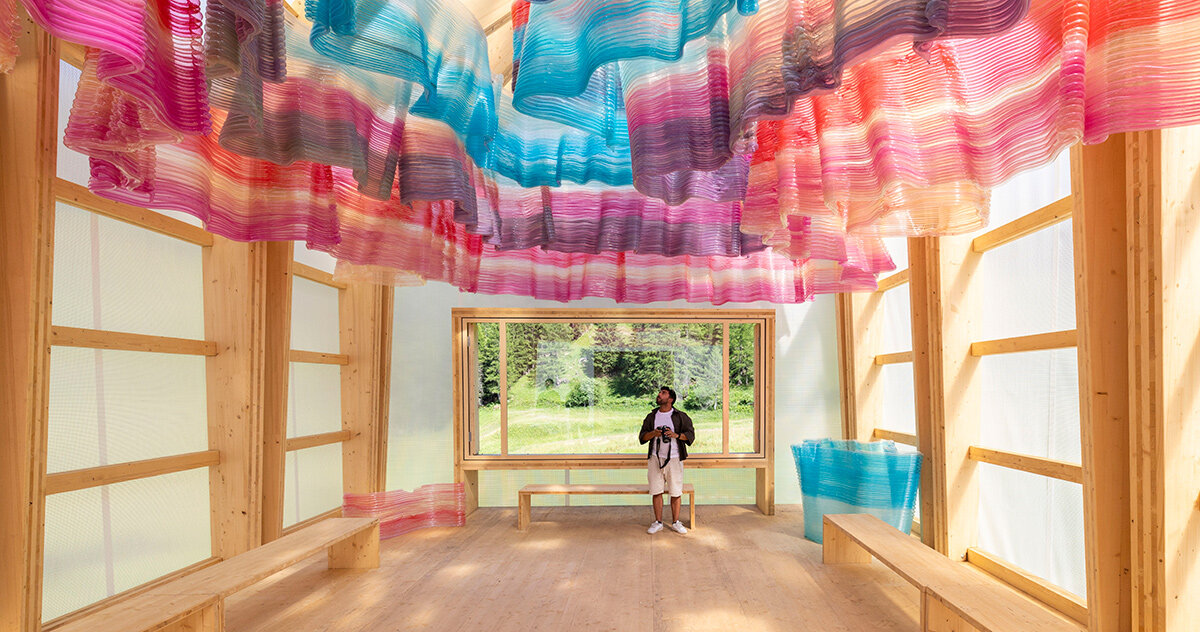
Once confined to the aerospace and automotive industries, composite materials have taken on an increasingly central role in contemporary architecture. By combining two or more components, such as fibers and polymers, they offer lightness and strength, high durability, formal freedom, and enhanced environmental performance. Their incorporation into architectural practice marks a profound transformation in how we design, fabricate, and inhabit space.
Following the news of Frank Gehry's passing at age 96, renewed attention has been directed toward a career that significantly shaped architectural discourse from the late 20th century onward. Over more than seven decades, Gehry developed a design language defined by material experimentation, iterative model-making, and an interest in fluid, expressive forms. His work ranges from early residential interventions in Southern California to major cultural institutions that have contributed to the identity of cities around the world.
The Dokkaebi Market Customer Support Center, designed by YZA, is a public complex supporting the traditional Dokkaebi (Goblin) Market in Nowon-gu, . Positioned at the entrance to the market, the building occupies a transitional site, where a quiet residential alley to the south meets the dense commercial activity of the market to the north. Within this dual context, the project was developed as an architectural gateway connecting two distinct urban conditions.
Positioned on either side of the main lobby entrance, the walls measure six meters in height and nine meters in length, creating a sculptural threshold between the exterior and interior. The project draws from the movement of the nearby Gulf, translating the dynamics of water into a series of fluid, wave-like forms. Each surface is composed of thousands of flowing lines that shift in density and depth, producing a tactile gradient that interacts with natural and artificial light throughout the day.
The center is tucked into a hillside clearing where a stream enters from the east. Archi-Union retained the dense bamboo grove and arranged the program around a small courtyard that steps upward with the slope. Activity spaces occupy the lower two floors, and a third-floor terrace opens to mountain views. This vertical layering creates a parallel relationship with a nearby cliffside and frames distant fields through roof apertures, inspiring its name, 'Cloud Eye.'