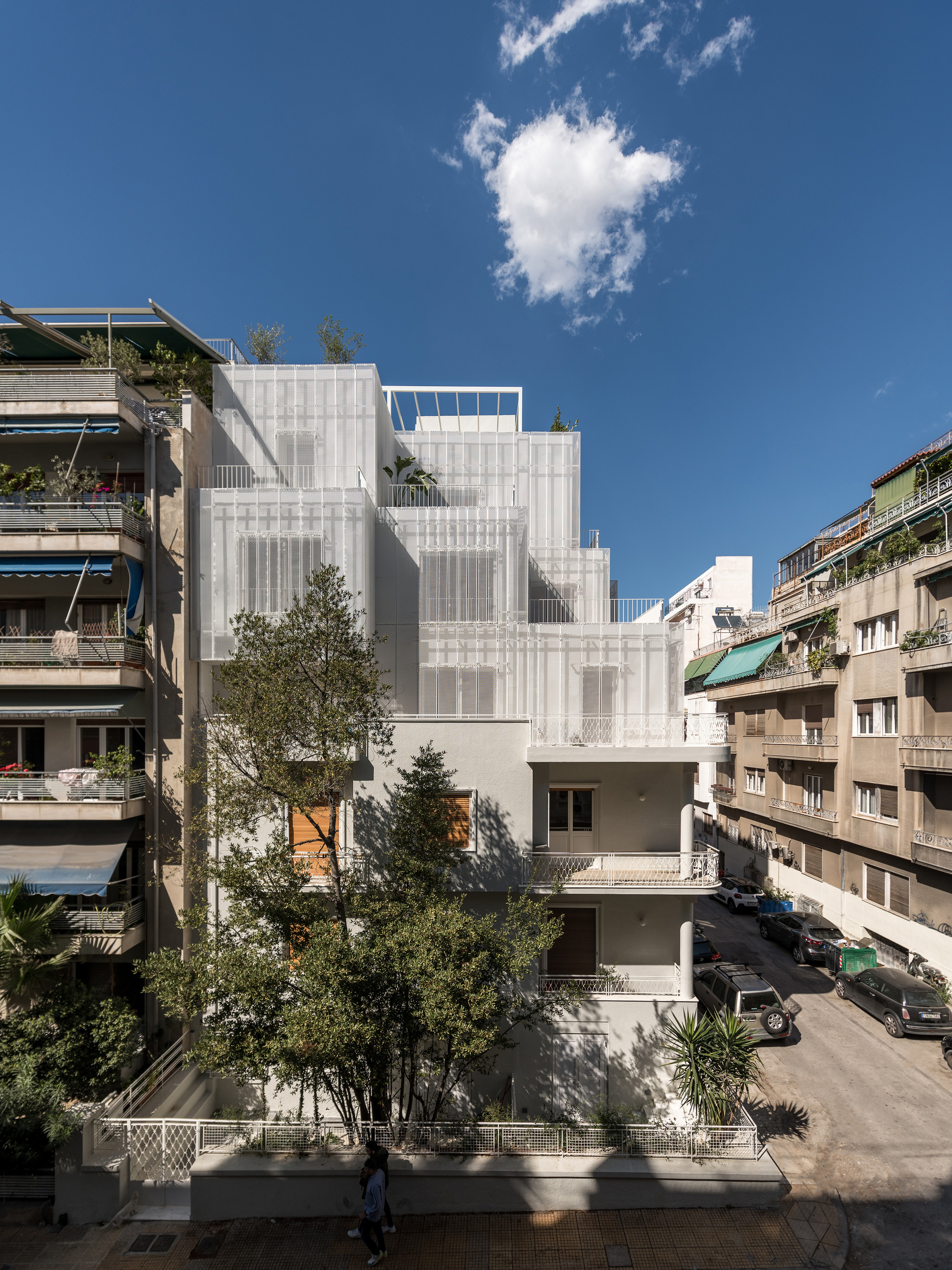
Prada has unveiled new scaffolding on its building, currently undergoing renovation, that covers its facade in rippling layers of semitransparent Prada-green scrim paper. The result is a beautifully nuanced design solution that turns what's typically a functional safety requirement into a moiré urban dreamscape that becomes a visual extension of Prada's brand.
A bench in Bristol installed facing a brick wall has aroused local curiosity why put it there? BBC West commented that it joined other perversely placed seating: a bench in Shirehampton facing a derelict building and one in Wedmore facing a hedge. Bristol city council explained that when it plants a planned tree, the bench will provide a shady spot to rest on a steep hill, but promised to review the placement.
This past week in New York City, fifteen inches of snow fell and more than twenty-two hundred snowplows pushed it away. Twelve thousand miles of sidewalk were shovelled. Two hundred and nine million pounds of salt were spread, and, after it got really bad, two hundred thousand gallons of calcium chloride, a chemical ice melt, were deployed. Sometimes the work you do leaves its mark; sometimes it doesn't.
Across this week's broader architecture news landscape, a central theme emerges around the advancement of civic architecture conceived as open, publicly engaged infrastructure, with cultural and institutional projects increasingly designed to strengthen their relationship with the city and everyday urban life. At the same time, renewed global attention turns toward Africa, where large-scale transport infrastructure and the conservation of modernist landmarks reflect interests in the region and the reassessment of the continent's architectural heritage.
In an attempt to assuage concerns that the proposed four-story building to replace the shuttered Western Plywood warehouse at 2600 Harrison Street in the Mission is incompatible with the "design, scale and mass" of the neighborhood, Kerman Morris Architects has redesigned the project. The new design reduces the street-level wall along Harrison, includes a more open Production, Distribution & Repair (PDR) space, and adds an area with benches and raised planters along the street.
Unlike most popular sports, the origin of basketball has a precise year and creator: it was invented in 1891 in the United States by Canadian physical education instructor James Naismith as an indoor sport for athletes at Springfield College during the winter, after the end of the football season. The sport quickly expanded beyond U.S. borders, being included in the Olympic Games in 1936 and achieving international popularity after the Second World War.
Text description provided by the architects. In the heart of Marmilla, architect Martino Picchedda transforms the village's main entrance into a poetic urban threshold. The design evokes the timeless forms of the Giants' Tombs while celebrating the Sardinian landscape's identity through corten steel, local stone, and light. Here, history and contemporary design converge, creating a welcoming space that tells the story of place and people.
Jiaxing High-Speed Rail New Town Cultural Center sits at a key node in the city's water and landscape network, with open waterfronts to the north and west and major roads to the south and east. Conceived as the City Living Room and Eye of the Town, it anchors the community core, surrounded by residences, schools, and the hospital. It aims to provide the public with a high-quality, all-day accessible experience.
It's hard to think of two more fundamental social needs than a) not being forced to relieve yourself on the street and b) not having other people relieve themselves on the street yet the public toilet is an ignored and vanishing public amenity. The British Toilet Association reports that 40% of public toilets have closed since 2000 Victorian facilities in particular attract developers, not least because their dignified buildings endure: solidly built, centrally located and still embedded in the daily flow of the city.
Coming Together features examples from more than 60 U.S. cities, both large and small, highlighting lessons learned and opportunities embraced in the wake of the COVID-19 pandemic as communities adapt to lasting changes in work, housing, mobility, entertainment, and recreation. The exhibition is currently open to the public and will remain on view through Fall 2026.
My hope is that this new community building and George Street public plaza will become a cherished destination in Sydney's city center, a generative place for people to connect, recharge, reflect, and take a pause from the rhythm of a fast-transforming city.
Like many American cities, the streetscape in downtown Brooklyn was for a long time very heavy on the street: a great place to park a car or drive through. But over the past 20 years, the area itself has gone from being a 9-to-5 shopping and business district to one where a growing number of people live 24-7. Since 2004, more than 22,000 housing units have been added to the neighborhood, changing its character so much that its old streetscape just wasn't cutting it.
The main improvements that developers Shaftesbury Capital want to make to the area include new signage, upgrading the lighting and introducing more planting. The plans also want to take Carnaby back to its roots by making it look more like a road again. The street would remain pedestrianised, but could have a 'road' and pavements re-installed. The developers want to un-do a lot of the changes that were made in the '80s and '90s when artificial stone paving was installed.
At first glance, the Shift Pro looks like your typical modern street pole with a minimalist black finish. But here's where it gets interesting: this thing can be equipped with up to four independently manageable modular heads. Each head can be customized to serve different functions, from adjustable LED lighting to IP67 security cameras, passive acoustic speakers, or Wi-Fi access points. Oh, and if you're riding an e-bike or electric scooter, there's even an optional door with an electrical socket for charging.
After months of gathering local feedback, the DOT narrowed its redesign plans into two options [PDF]: Option 1 offers a straight "promenade" design that divides pedestrian plazas and "shared traffic" lanes into parallel corridors, whereas Option 2 offers a zig-zagging "meander" design that switches the pedestrian plazas and the shared traffic lanes at every intersection.
The scale of the estate is felt in the sweeping view of its terrace blocks rising over the central green. Narrow balconies wrap the long facades, filled with red flowers, potted plants, and the everyday objects of residents. Below, a lawn dotted with picnics and a small playground softens the geometry, revealing the original intention of the architects to merge high-density housing with generous public space.
It's estimated that there are more than 9,000 of these "construction sheds" (another term for scaffolding) installed across the city, enough to stretch nearly 400 miles if they were put end to end. They do the important work of shielding pedestrians from potential falling debris during building construction and renovation projects, but they also shroud large swaths of sidewalk in dark and cloistered tunnels made of an unfortunate jumble of steel poles and plywood.
Moving walkways, or "people movers" as they're sometimes called, can be found in most major American airports. And, at least in theory, they serve a pretty important function-moving a bunch of very rushed people, very short distances, a little quicker than they can on their own two feet.
The basketball arena is hardly the second thought here, but it's much more a piece of this broader civic space than the typical pro sports facility. Especially compared to the U.S., where the stadium is often the only element of such a project, Roig Arena and its public amenities offer a refreshing take on a form of urban development that favors the "development" over the "urban." Open since September, the project was designed by the international architecture firm Hok and Valencia-based Erre.
When Hudson Yards opened in Manhattan in 2019, it promised a new urban neighborhood built from scratch. 16 towers with 4,000 residential units were erected in hopes of creating a strong community. Despite its lavish amenities and lofty public plazas, a peculiar emptiness persisted. The development felt anonymous, speaking to a fundamental truth about human social capacity. Where architectural ambition outpaces human cognitive limits, the potential for intimacy collapses.
We're talking about the so-called "protected bike intersection," or as a few outraged drivers have memorably called it, an "anti-car labyrinth," a "borderline anti-human" street treatment, and an "eco-fascist" "acid trip" of roadway infrastructure. So we especially love how Oh the Urbanity breaks down not just why those reactions are wrong, but why bike intersections are "the number one type of bike infrastructure that most cities are lacking."
From Greek Street's gilded snail to vintage adverts on a Poland Street car park - Soho's streets are alive with layers of visual heritage, and now, for the first time, all of that history has been brought together in one place. The Soho Heritage Map, created by the Soho Neighbourhood Forum, is a new website that maps the surviving heritage of the Soho area.
Blaz Cuk, born in Slovenia, is the founder of the Berlin-based fashion brand Obectra. stands at the intersection of sustainable fashion, urban culture, and subversive art. With a distinctive vision that blends innovative design with daring aesthetics, Cuk is redefining contemporary clothing while drawing inspiration from Berlin's vibrant techno underground scene and the BDSM subculture. Upon relocating to Berlin, a city celebrated for its dynamic fashion landscape and progressive ethos, Cuk founded Obectra.
Through a range of installations, models, and interactive elements, "Age of Nature" presents speculative yet achievable visions for future living. A tower of live mushrooms grows as a vertical field, freeing ground space for wilderness; facades are reimagined as miniature ecosystems; and filmmaker Liam Young's The Great Endeavor envisions a global workforce collectively removing CO₂ from the atmosphere using existing technologies. Together, these projects question how architecture can move beyond minimizing its impact to actively regenerate the environments it inhabits.
Last fall, Philadelphia's Center City District (CCD) launched Open Streets: West Walnut on a series of Sundays. One Sunday at a time, the program showed off Center City's innate vibrancy when it catered to people and not cars. CCD provided some light programming, such as musical acts and dance performances, as well as more casual DIY programming, such as corn hole and ping pong, and a few seating pods.