Larry Ellison, executive chair and chief technology officer, founded Oracle Corp. ( NYSE: ORCL) in 1977. Recently, it has become a tech behemoth, largely because of its key position in the burgeoning artificial intelligence (AI) business. His net worth, according to the Bloomberg Billionaire list, is $283 billion, which makes him the second-richest person in the world. That net worth has risen by $91 billion since the start of the year, largely because of Oracle's success.
Amazon's $35bn investment will build on the $40bn already invested in India - establishing the company as "the largest foreign investor" in India, the company said in a statement. A key component of it will go into local cloud and AI infrastructure. Microsoft's fresh commitment follows a $3bn investment announced by the company earlier this year.
It wouldn't be the first time in the history of this industry that there would be a correction, and that's fine, you know. So we would adjust, and we would be just fine in the end. But I don't see it at this point in time. Right now, I don't see any signs of a slowdown based on the projects that are in the market right now and the conversations and the plans that we're talking about with our customers," he said.
Skates later told Business Insider that Amplitude leaders used AI tools like Cursor to "lead from the front." Executives worldwide are developing expansive, costly AI initiatives. Amplitude CEO Spenser Skates says a lot of the industry's buy-in is thanks to Sam Altman. Skates cofounded the publicly traded analytics company, which he said has about 800 employees. On the " Lightcone Podcast," Skates acknowledged that some engineers were skeptical of their company leaders' rapid adoption of AI.
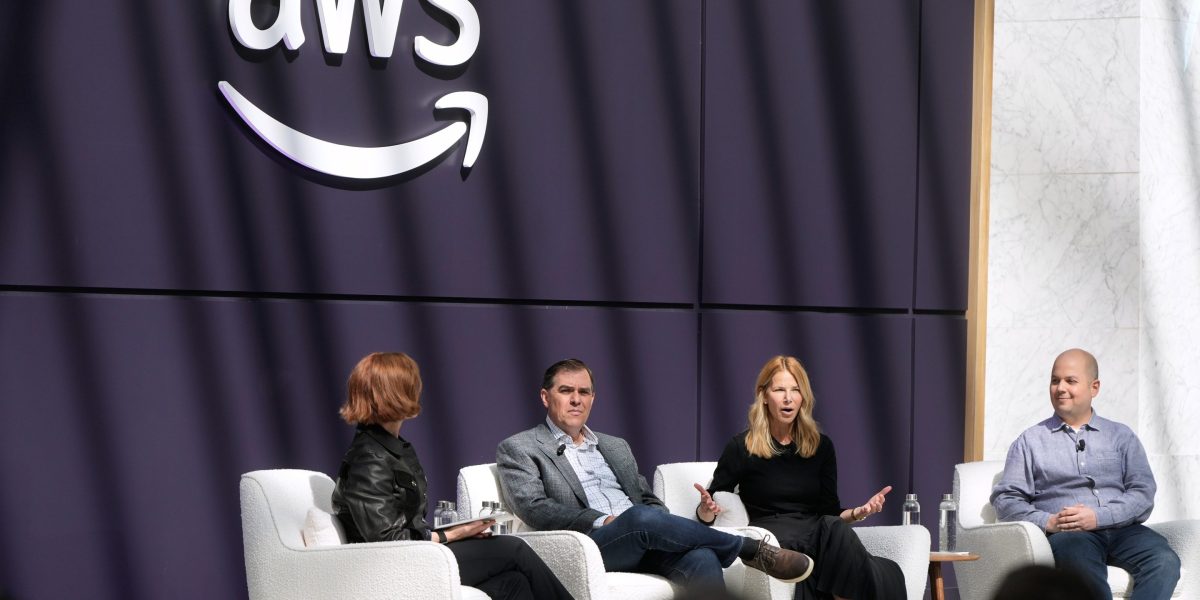
Some of the world's most powerful and well-connected leaders converged in Manhattan on Wednesday, and one subject dominated the room: artificial intelligence. Three years after ChatGPT launched, revolutionizing the way the world thinks about and uses AI, the arms race is bigger than ever - perhaps too big. At the annual New York Times DealBook Summit, leaders from BlackRock's Larry Fink to Lai Ching-te, the President of Taiwan, were asked about the state of the AI industry and the potential for an AI bubble, a hot topic in Silicon Valley and on Wall Street over the past few months.
Microsoft and Nvidia are investing $5 billion (€4.3 billion) and $10 billion (€8.6 billion) respectively in Anthropic. The creator of Claude has committed to spending $30 billion on cloud services with Microsoft. The deal reduces OpenAI's dependence on the AI industry. The AI sector is seeing a shift in the balance of power. For years, Microsoft was closely linked to ChatGPT creator OpenAI through substantial investments and collaboration. Microsoft is now investing up to $5 billion in Anthropic, while chipmaker Nvidia is committing up to $10 billion. Both parties are committing to the next round of financing for the ChatGPT competitor.
The launch of ChatGPT by OpenAI in November 2022 marked a turning point in the AI landscape, igniting the broader AI boom. This generative AI tool demonstrated practical applications for everyday users, from content creation to coding assistance, sparking massive public interest and investment. Tech giants poured billions into AI development, while startups flooded the ...
Masayoshi Son isn't known for half measures. The SoftBank founder's career has been studded with brow-raising bets, each one seemingly more outrageous than the last. His latest move is to cash out his entire $5.8 billion NVIDIA stake to go all-in on AI, and while it surprised the business world on Tuesday, it maybe should not. At this point, it's almost more surprising when the 68-year-old Son doesn't push his chips to the center of the table.
The amount of money being spent on artificial intelligence is astronomical. Investors have lavished the top tech companies and startups alike with hundreds of billions of dollars - so much so, in fact, that an estimated 92 percent of US GDP growth now comes from AI. If trends continue in 2026, conservative estimates peg the spending from just the "largest technology firms" at $550 billion.
The company's chief executive, Johan Svanstrom, said AI was "becoming absolutely central" to the running of the business and its plans for the future. But investors were less enthusiastic, and Rightmove's shares had sunk by more than a quarter at one point on Friday. Rightmove announced plans to invest 60m over the next three years and a large part of this investment will focus on AI.
From the reciprocal, and some have said circular, nature of hundreds of billions in commitments in investment, tied to future chip purchases, to the extent to which GDP growth is reliant on this boom, some have said this is a bubble. A Harvard economist estimates 92% of US GDP growth in the first half of 2025 was due to investment in AI.
The platform simplifies social media engagement by automating conversations through Instagram, Facebook, and WhatsApp. What started as a messenger automation startup has evolved into a global community of over one million users across 170 countries, backed by a team of more than 350 employees. In April 2025, Manychat announced it had raised $140 million in growth capital led by Summit Partners to accelerate AI innovation, global expansion, and product development. This milestone underscores the company's accelerating momentum and growing influence in the creator economy.
The broad index of large-cap companies in the S&P 500 closed flat, but the tech-heavy Nasdaq 100 rose 0.55%. Tech stocks were led by Nvidia, which was up 3%, and now has a market cap of more than $5 trillion. (Its stock is down 0.7% premarket this morning, suggesting that some traders are taking their overnight gains.) To put that in perspective, Nvidia's market cap is bigger than the GDP of every G7 country except the U.S. and Japan.
Is the UK truly becoming an AI hub as US tech giants pour in billions? A multibillion-dollar deal is being hailed as proof that Britain is becoming a global hub for artificial intelligence, with major United States tech companies investing heavily. But the reality is a little less straightforward. On today's show, we ask: how much power, and how much of your personal data, are you willing to hand over to tech companies?