Careers
fromEntrepreneur
1 day agoThe 5 Stages of Career Growth - and What It Takes to Reach the Next One
Advancing your career requires evolving visibility, trust, and influence, not just improving performance.
"This year's increase in undergraduate credential attainment isn't just about more completions-it's also about timing. More students are earning certificates and degrees earlier and that shift reflects how postsecondary pathways are changing and starting sooner than they once did."
Customer service skills define how effectively employees represent a brand and resolve customer needs. In every industry, these skills determine whether a business builds loyalty or loses trust. Customers today expect responsiveness, empathy, and accuracy across every touchpoint-from phone calls and chats to social media interactions.
EC-Council, creator of the world-renowned Certified Ethical Hacker (CEH) credential and a global leader in applied cybersecurity education, today launched its Enterprise AI Credential Suite, with four new role-based AI certifications debuting alongside Certified CISO v4, an overhauled executive cyber leadership program. The dual launch is the largest single expansion of EC-Council's portfolio in its 25-year history. It addresses a structural gap that no single tool, platform, or policy can solve alone: AI is scaling faster than the workforce trained to run, secure, and govern it.
Bob and I have spent many years as Python devs, and 6 years coaching with Pybites and we can safely say that being a Senior Developer is only about 1/3 Python knowledge. The other 60% is the ecosystem. It's the tooling. It's all of the tech around Python that makes you stand out from the rest. This is the biggest blind spot keeping developers stuck in Tutorial Hell. You spend hours memorising obscure library features, but you crumble when asked to configure a CI/CD pipeline.
To successfully repair after a mistake, you need to acknowledge and name the mistake, validate the other person's feelings and viewpoint, and create a plan for the specific actions you will take to prevent this mistake from occurring again.
One of my favorite movies is Good Will Hunting. Will Hunting (played by Matt Damon) is a 20-year-old janitor at the Massachusetts Institute of Technology. Although he works a blue-collar job, he is secretly a self-taught genius with an extraordinary gift for mathematics and an exceptional memory. One day, he anonymously solves a complex math problem left on a chalkboard by Professor Gerald Lambeau, astonishing the faculty.
I belong to six professional organizations. Or maybe it's 13, 19, 26, or 47. I can't be sure. The ones where I pay dues or volunteer I know well: ASIS International, the Life Safety Alliance, Chartered Security Professionals, and a couple of others. Then come the niche and industry-specific associations like the International Council of Shopping Centers, public-private partnerships such as OSAC and Infragard, and the countless ASIS Communities.
Organizations have reported heightened cybersecurity risks as a result of these skill shortages, but the issues don't end there. Many teams will also experience burnout, which is an issue for security teams even in the best of times, which can only add to the talent gap concern if burnt out employees leave the industry.
Young people are "experiencing higher education differently, and that is shaping much of what parents are saying," said Lammers. "[Parents] are reacting to the questions their children are asking and trying to find the best way to help them navigate the next steps."
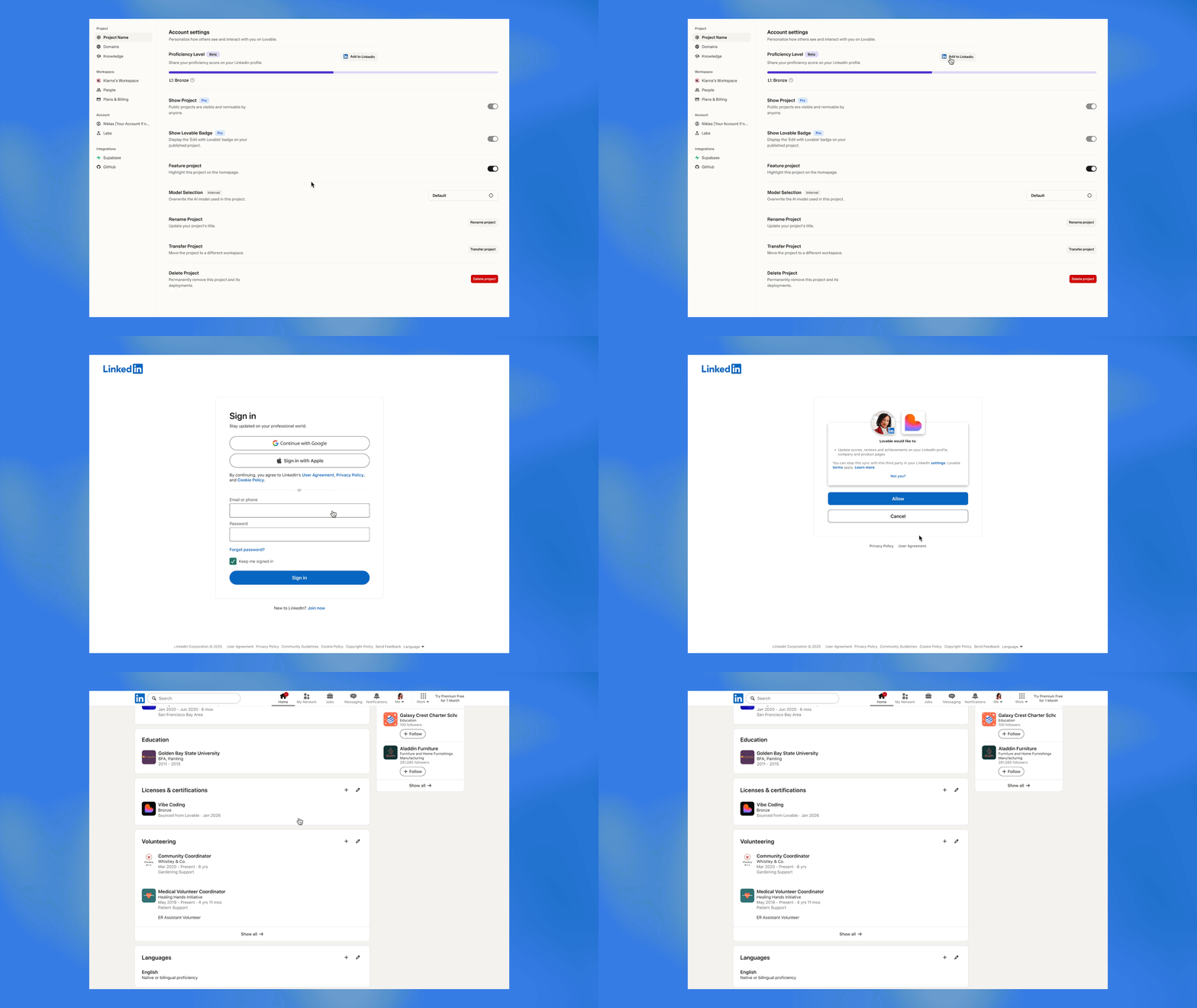
LinkedIn is taking steps to prove that job candidates really have they skills they claim. The Verified AI Skills program unveiled in January involves LinkedIn partnering with AI tool providers to automatically validate and display a user's proficiency directly in their certification section. The initial partners include Lovable, Replit, Relay.app, and Descript, which will track AI proficiency of candidates using their tools to create AI apps.
Many professionals focus on big projects and headline achievements, but research shows that soft skills and visibility strongly influence promotions. LinkedIn data reveals that employees who combine hard and soft skills get promoted about 8% faster than those who focus only on technical abilities, and skills like communication, teamwork and problem solving are linked to promotions up to 11% faster. Regularly updating and showcasing your skills is also tied to faster advancement.
"I always wanted this job -- I worked towards it," he said. "If you want to climb the ladder, you've got to try things that are outside your comfort zone, which I certainly have. That means I've made mistakes along the way."